
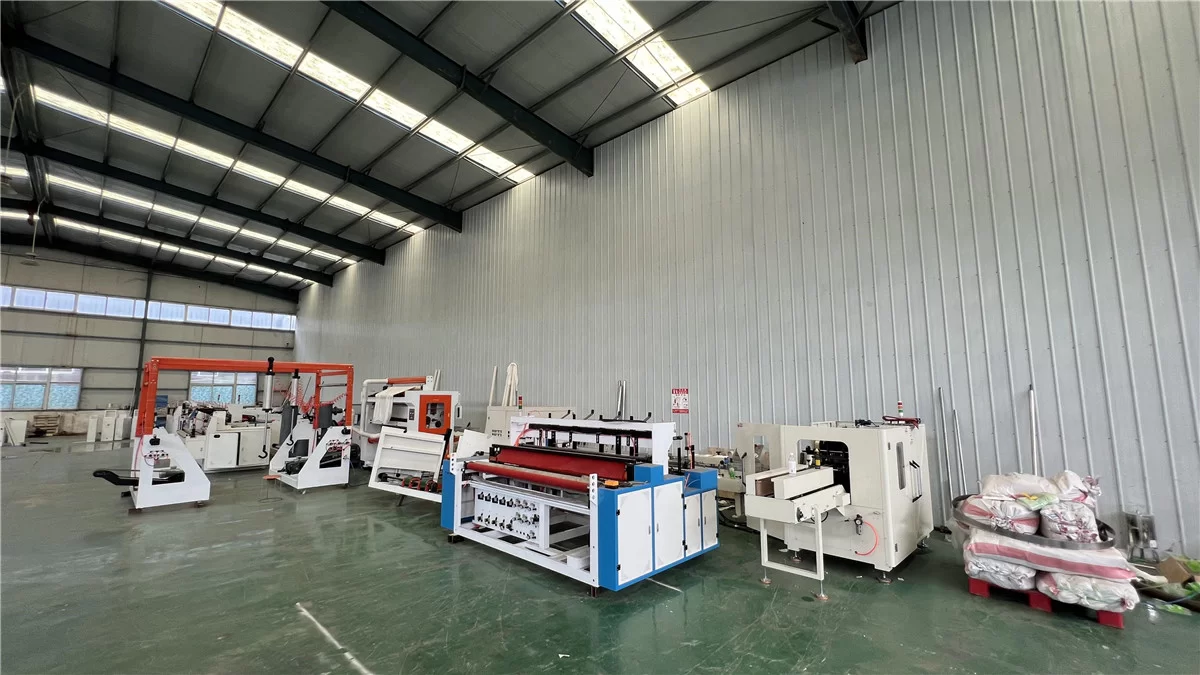
Function, configuration and line compatibility
Review how the machine works, what it can produce and which optional functions or supporting equipment may be needed for the complete process.
Machine overview and suitable production use
V-Fold Facial Tissue Production
The 7-lane V-fold facial tissue machine converts jumbo tissue rolls into counted interfolded tissue logs. After cutting, the finished tissue stacks can be packed in soft bags or placed into facial tissue boxes.
The machine should be configured around the finished folded sheet and pack rather than selected only by the number of lanes. Sheet dimensions, number of plies, sheets per pack, raw material and downstream packing method all affect the production arrangement.
Main Machine Functions
Jumbo tissue roll unwinding
Paper web alignment and tension adjustment
Multi-ply paper feeding
V-fold interfolding
Sheet counting
Tissue log formation
Finished log discharge
The vacuum system, folding components and paper-feeding arrangement work together to maintain the required overlap and stack structure.
Product Specifications to Confirm
Unfolded sheet length and width
Finished folded dimensions
Number of plies
Paper basis weight
Sheets per pack
Finished stack height
Soft-pack or box dimensions
Required production capacity
The folded sheet size affects the folding components and finished tissue log. The number of sheets per pack affects counting, cutting and packing. These specifications should be confirmed before the machine is manufactured.
Paper Feeding and Alignment
Several paper webs enter the folding section at the same time. Stable alignment is important because web movement can affect the folded edges and interfolding overlap.
Paper basis weight, softness, tensile strength, moisture and jumbo roll condition can influence feeding stability. Representative production material should be used during testing whenever practical.
Folding and Tissue Log Formation
The V-fold process creates an interfolded structure that allows the next sheet to rise when one sheet is removed from the pack.
The operating team should check folding overlap, sheet alignment, counting and tissue log shape during repeated operation. A short unloaded demonstration cannot fully represent performance with the intended paper.
The tissue log must also match the accepted dimensions of the downstream log saw. Excessive compression or unstable log formation may affect cutting and packing.
Matching the Log Saw
The facial tissue log saw cuts the long folded tissue log into individual finished stacks. The cutting range must match the log width, height and length produced by the folding machine.
Cut quality is influenced by blade condition, tissue softness, stack density and operating settings. The transfer between folding and cutting should protect the tissue from unnecessary deformation.
Soft-Pack and Box Packing
Soft-pack facial tissue and box facial tissue use different packaging arrangements.
A soft-pack machine may complete film feeding, bag formation, tissue-stack insertion, sealing, cutting and finished-pack discharge. Box packing requires a carton that matches the finished tissue stack and extraction opening.
The packing equipment should be selected according to:
Tissue stack dimensions
Sheets per pack
Film or box specification
Printed registration requirement
Target finished-pack output
Automation and Operator Work
The folding and counting processes can operate automatically after the material has been prepared and threaded. Connected cutting and packing equipment can reduce manual transfer between production stages.
Operators are still required for jumbo roll replacement, initial paper threading, vacuum and folding adjustment, material inspection, packing-film replacement, product changeover, cleaning and maintenance.
Production-Line Balance
The output of the complete line is determined by its slowest connected stage. A high folding capacity does not automatically produce the same number of finished packs if cutting or packing cannot keep pace.
Folding, cutting, transfer and packing capacities should be compared using the same finished-product specification.
Information Required for Configuration
Provide the jumbo roll width and diameter, paper basis weight, number of plies, unfolded and folded sheet dimensions, sheets per pack, packing format, target output and workshop conditions.
A finished tissue pack or detailed product drawing can help confirm the folding, cutting and packing arrangement.
How the machine processes the material
The 7-lane V-fold facial tissue machine converts jumbo tissue rolls into continuously interfolded and counted tissue logs. The folded logs are subsequently cut into individual stacks for soft-pack or box facial tissue production.
Jumbo Roll Loading and Paper Feeding
Jumbo tissue rolls are installed on the unwind stands according to the required number of plies. Each paper web is drawn into the machine separately and guided toward the folding section under controlled tension.
The operator adjusts the unwind tension according to the paper basis weight, tensile strength, softness and roll condition. Stable web feeding is important because tension variation can affect sheet alignment and folding accuracy.
Ply Combination and Embossing
The individual paper webs are combined before entering the folding section. Edge embossing can be used to help prevent ply separation. Other embossing or lamination arrangements may be added when required by the finished facial tissue specification.
The embossing pressure should hold the plies together without unnecessarily compressing or damaging the tissue.
Slitting and Lane Distribution
The combined tissue web is divided into the required working lanes. Each lane feeds paper into its corresponding folding mechanism. The effective raw-material width and finished tissue width determine the lane arrangement and usable working width.
Vacuum Interfolding
The folding system uses controlled paper feeding and vacuum assistance to form the V-fold interlocking structure. When one finished sheet is pulled from the package, the following sheet is partially presented through the package opening.
Correct folding depends on paper tension, vacuum stability, folding-component adjustment and the properties of the tissue material.
Counting and Tissue Log Formation
The machine counts the folded sheets according to the required pack quantity. The continuously folded tissue is formed into a long tissue log with a controlled height and stack structure.
The tissue log dimensions must match the downstream log saw and packing equipment. Unstable stacks, incorrect overlap or inaccurate counting may affect cutting and packaging.
Log Discharge and Downstream Processing
The completed tissue log is discharged and transferred to a facial tissue log saw. The saw cuts the long log into individual tissue stacks according to the required pack width.
The cut stacks can then enter a soft-pack tissue packing machine or box tissue packing process. For connected production, the folding, cutting, transfer and packing capacities should be matched using the same finished-product specification.
Machine data for configuration review
| Machine Model | 7-Lane V-Fold Facial Tissue Machine |
|---|---|
| Folding Type | V-fold interfolding |
| Number of Working Lanes | 7 lanes |
| Suitable Raw Material | Jumbo tissue rolls suitable for facial tissue production |
| Suitable Finished Products | Soft-pack facial tissue, box facial tissue and other supported V-fold interfolded tissue products |
| Effective Working Width | Insert the actual usable working width from the machine technical specification |
| Unfolded Sheet Size | Confirm according to the required tissue product |
| Folded Sheet Size | Confirm according to the soft-pack or box specification |
| Number of Plies | Confirm according to the finished product and raw material |
| Counting Range | Confirm according to the required number of sheets per pack |
| Embossing System | Edge embossing or another confirmed embossing configuration |
| Folding System | Vacuum-assisted V-fold interfolding |
| Design Speed | Insert the verified machine design speed and applicable measurement unit |
| Reference Output | Confirm according to the paper specification, sheet dimensions, number of plies, sheets per pack and continuous working conditions |
| Total Power | Insert the total installed power for the selected configuration |
| Overall Dimensions | Insert the verified length × width × height of the final machine |
| Vacuum System | Confirm the vacuum pump and corresponding installed-power requirement |
| Supporting Equipment | Facial tissue log saw, stack-transfer conveyor, soft-pack tissue packing machine, box packing equipment and bundle packing machine |
The number of lanes does not independently determine finished-pack output. Practical output also depends on the tissue width, sheet count, paper quality, log cutting capacity and packing-machine rhythm.
Functions available by requirement
Machines used before or after this process
Design speed and reference output are not the same value. Practical production depends on raw material, finished-product dimensions, machine configuration, operator preparation and the capacity of connected equipment.