
Process, equipment connection and operating requirements
Review how the complete line is arranged, which finished products it supports, how packaging is handled and what factory conditions should be confirmed.
Production process and equipment connection
Connected Production from Jumbo Roll to Soft Pack
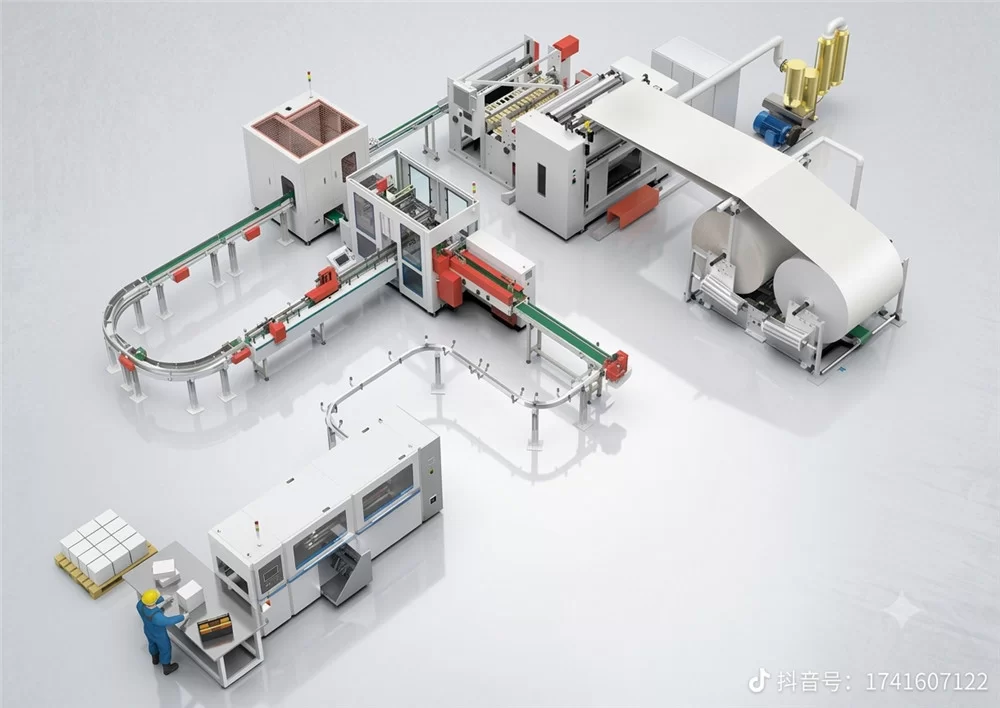
The 7-lane automatic soft pack facial tissue production line connects tissue folding, log cutting, product transfer and retail packaging into one coordinated process.
The production line is intended for factories with stable facial tissue specifications, repeat orders and a need to reduce manual transfer between the main processing stages.
The complete line should be selected around the finished tissue pack. A high folding speed alone does not represent the final output if cutting, transfer or packing cannot operate at a matching rate.
Finished Product Requirements
Before the line configuration is prepared, the customer should confirm:
Unfolded tissue sheet dimensions
Finished folded dimensions
Number of plies
Paper basis weight
Number of sheets per pack
Finished stack dimensions
Soft-pack bag dimensions
Film width and thickness
Printed film registration requirement
Target finished-pack output
A physical pack sample or complete dimensional drawing can help clarify the tissue and packaging requirements.
Production Process
Jumbo tissue roll loading
Paper web feeding and alignment
Ply combination
V-fold interfolding
Sheet counting
Tissue log formation
Automatic tissue log cutting
Finished-stack transfer
Automatic soft-pack feeding
Film forming and sealing
Finished-pack discharge
Optional bundle or carton packing
Equipment Composition
7-Lane V-Fold Facial Tissue Machine
The folding machine receives several tissue paper webs and produces continuously interfolded tissue logs. Paper feeding, vacuum response, folding overlap, sheet counting and stack formation must remain coordinated.
The number of lanes provides a basis for the working width and folding capacity, but final output also depends on the finished sheet, tissue quality, cutting and packing equipment.
Facial Tissue Log Saw
The log saw cuts the long folded tissue log into individual stacks. The accepted tissue log width, height and length must match the output of the folding machine.
Blade condition, tissue softness, stack density and cutting settings influence the finished cut. The transfer into and out of the cutting section should limit unnecessary stack deformation.
Stack Transfer System
The transfer system moves the cut tissue stacks toward the packing machine in the required direction and spacing.
Depending on the complete configuration, the transfer section may include conveyors, stack separation, positioning, buffer accumulation and packer-feeding devices.
Automatic Soft-Pack Tissue Packing Machine
The packing machine completes tissue-stack feeding, film tracking, bag formation, product insertion, sealing, cutting and finished-pack discharge.
The film specification should remain consistent. Film thickness, width, sealing properties and printed registration can affect continuous packing performance.
Line Capacity Balance
The practical output of the complete line is determined by the slowest connected process.
The configuration review should compare:
Folding capacity
Tissue log formation
Log cutting capacity
Stack-transfer capacity
Retail packing capacity
Film replacement time
Product changeover time
Secondary packing capacity
Short buffers can reduce the effect of brief interruptions, but they cannot correct a large capacity mismatch between machines.
Automation Details
Automatically Completed Operations
Paper web feeding after initial threading
V-fold interfolding
Sheet counting
Tissue log formation
Automatic log cutting
Finished-stack transfer
Film feeding and bag formation
Product insertion, sealing and cutting
Finished-pack discharge
Operator-Assisted Operations
Jumbo roll loading and initial paper threading
Machine setup and product changeover
Packing-film replacement
Product sampling and quality inspection
Fault handling and cleaning
Routine maintenance
Carton preparation and warehouse handling unless additional equipment is included
Fully automatic describes the connection of the principal converting, cutting and packing stages. The line still requires trained personnel.
Raw Material Requirements
Jumbo tissue rolls should be confirmed for width, diameter, number of plies, basis weight, tensile strength, softness, moisture and roll condition.
Material properties can influence:
Paper web alignment
Vacuum folding stability
Folding overlap
Finished stack shape
Cutting quality
Packing performance
Representative production material should be used during factory testing whenever practical.
Packaging Options
The primary output is soft-pack facial tissue. The pack can use plain or printed film according to the customer’s retail requirements.
Optional downstream packing can include:
Multi-pack bundle packing
Outer bag packing
Case packing
Carton sealing
Finished-pack conveying
Secondary packing should be selected from the actual wholesale and distribution method rather than added without a confirmed pack arrangement.
Workshop and Utilities
The connected line requires sufficient length for equipment interfaces, product-transfer sections and maintenance access.
The factory should prepare:
Jumbo roll storage and handling space
Electrical power
Compressed air
Vacuum system
Packing-film storage
Finished-pack collection
Secondary packing space
Maintenance and cleaning access
The layout should be confirmed using actual workshop dimensions, doors, columns, utility positions and material-flow direction.
Information Required for Final Configuration
Jumbo roll width and diameter
Paper basis weight and number of plies
Unfolded and folded sheet dimensions
Sheets per pack
Finished pack dimensions
Film specification
Target output
Secondary packing requirement
Workshop dimensions
Electrical and compressed-air conditions
These details allow the folding, cutting, transfer and packing equipment to be reviewed as one production system.
Primary and secondary packing options
Equipment arrangement and workshop flow
Practical output, operator quantity, installed power and workshop space depend on the final equipment combination, finished-product dimensions, packing format and operating conditions. Confirm these values in the final technical proposal.