
Process, equipment connection and operating requirements
Review how the complete line is arranged, which finished products it supports, how packaging is handled and what factory conditions should be confirmed.
Production process and equipment connection
2200 Semi-Automatic Toilet Paper Production Line
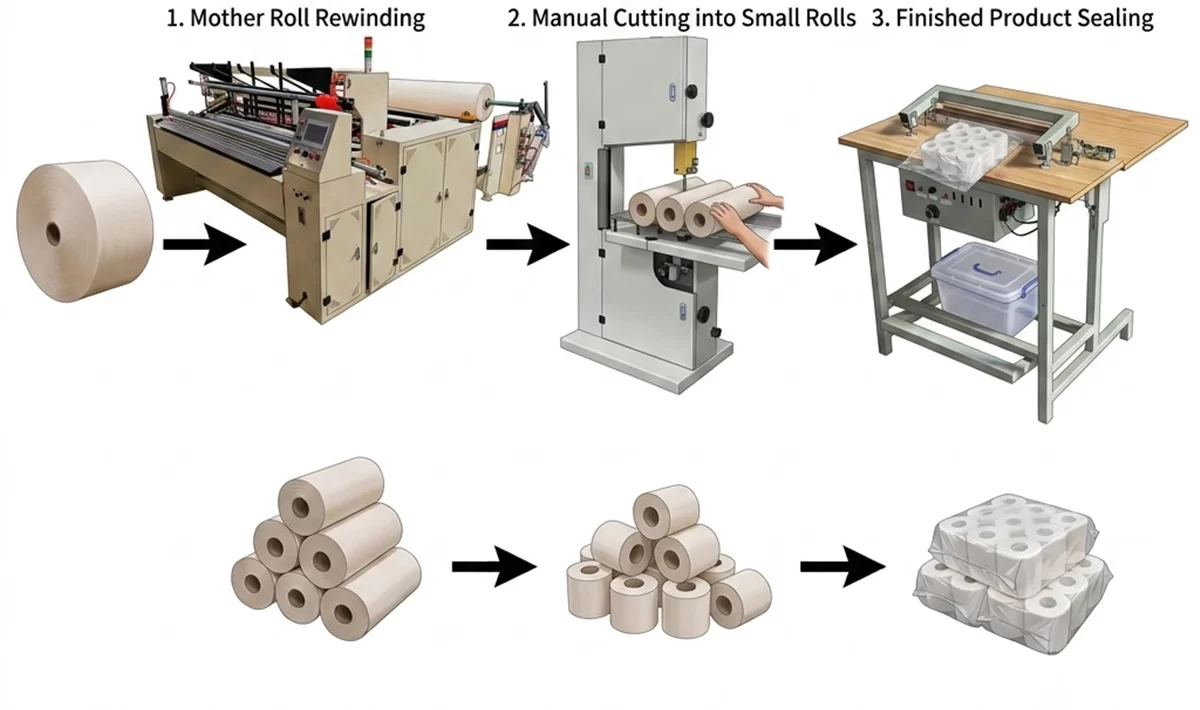
The 2200 Semi-Automatic Toilet Paper Production Line converts jumbo tissue rolls into embossed, perforated, cut and bagged toilet paper rolls. The standard configuration combines a 2200 mm toilet paper rewinding machine, a PE40 manual band-saw paper cutter and a re-500TS water-cooled bag sealing machine.
This configuration is intended for new converting factories and manufacturers that require a practical toilet paper production process without investing in automatic log cutting, roll conveying and fully automatic packing equipment.
The rewinding stage uses PLC and touch-screen control, while paper-log transfer, band-saw cutting, product arrangement and bag loading require operator involvement. The line should therefore be described as semi-automatic rather than fully automatic.
Suitable Finished Products
Standard household toilet paper rolls
Toilet paper rolls with cardboard cores
Coreless toilet paper rolls with the optional winding device
Embossed toilet paper rolls
Perforated one-ply and multi-ply toilet paper
Manually arranged multi-roll toilet paper bags
The finished roll diameter, width, sheet count, core diameter, embossing pattern and number of rolls per package must be confirmed before production begins.
Production Process
Jumbo Roll Loading and Paper Feeding
The jumbo tissue roll is installed on the single-layer rear unwind stand. The maximum raw paper width is 2200 mm, while the maximum jumbo roll diameter is approximately 1400 mm.
The standard configuration uses manual edge alignment and manual initial paper threading. An active guide roller in the belt transmission section assists with stable web feeding during production.
The listed maximum jumbo roll weight is approximately 0.5 t. The factory should prepare suitable lifting equipment for raw paper loading, replacement and removal.
Embossing and Perforating
The paper passes through a steel-to-wool embossing unit before rewinding. The embossing structure forms the required surface pattern and improves the appearance of the finished toilet paper.
The perforating unit produces tear lines according to the required market specification. The upper perforation blade uses an adjustable extension structure, which allows the machine to adapt the perforating depth to the paper quality and number of plies.
Correct perforation adjustment should maintain sufficient web strength during rewinding while allowing the finished sheets to separate cleanly during use.
Rewinding and Tail Sealing
After embossing and perforating, the paper is rewound into long toilet paper logs. The rewinding section controls the paper length, finished diameter, winding firmness and product discharge sequence.
The practical rewinding speed is approximately 80 to 150 m/min, with a reference design speed of up to 150 m/min. Actual speed depends on paper strength, basis weight, number of plies, embossing pressure, perforation and finished roll diameter.
A synchronous-belt-driven circular cutting and glue-spraying device completes paper-web cutting and tail sealing at the end of each rewinding cycle.
The completed toilet paper log is discharged through the automatic shaft-extraction and transfer mechanism. Operators then move the log to the manual cutting section.
Manual Band-Saw Cutting
The PE40 manual band-saw paper cutter divides the long toilet paper logs into finished retail rolls.
The cutter is suitable for paper logs with a diameter of approximately 40 to 140 mm. The finished cutting length can be adjusted from approximately 50 to 300 mm.
The operator positions and feeds each paper log manually. The blade is also sharpened manually. Cutting output therefore depends on operator experience, roll width, log diameter, blade condition and the required cutting accuracy.
The manual band saw provides a lower-investment cutting method, but its practical output is lower than an automatic log saw. It is suitable when the factory accepts operator-assisted production and does not require continuous high-speed cutting.
Product Inspection and Arrangement
After cutting, operators inspect the finished toilet paper rolls and remove irregular head and tail sections.
The inspection can include:
Finished roll width
Roll diameter
Cut-surface quality
Paper alignment
Embossing appearance
Perforation quality
Core position
Tail-sealing condition
Accepted rolls are counted and manually arranged according to the required retail or wholesale package.
Bag Loading and Water-Cooled Sealing
The arranged toilet paper rolls are placed into prepared packaging bags manually. The re-500TS water-cooled sealing machine then seals the bag opening.
The standard sealing length is 500 mm, while the sealing width is approximately 6 mm. The water-cooled structure assists with seal formation and cooling after the heating cycle.
The sealing machine does not automatically count, group or load the toilet paper rolls. Operators remain responsible for selecting the bag, arranging the products and positioning the package before sealing.
Main Equipment Composition
2200 mm toilet paper rewinding machine
Single-layer jumbo roll unwind stand
Paper feeding and guide-roller system
Raw paper break detection system
Steel-to-wool embossing unit
Adjustable perforating unit
Glue spraying and tail-cutting device
Automatic shaft-extraction and log discharge mechanism
PE40 manual band-saw paper cutter
re-500TS water-cooled bag sealing machine
Power control cabinet
Transformer
PLC and touch-screen control system
Reference Technical Parameters
<
| Production Line Name | 2200 Semi-Automatic Toilet Paper Production Line |
|---|---|
| Automation Level | Semi-Automatic |
| Maximum Raw Paper Width | 2200 mm |
Primary and secondary packing options
Equipment arrangement and workshop flow
Practical output, operator quantity, installed power and workshop space depend on the final equipment combination, finished-product dimensions, packing format and operating conditions. Confirm these values in the final technical proposal.