
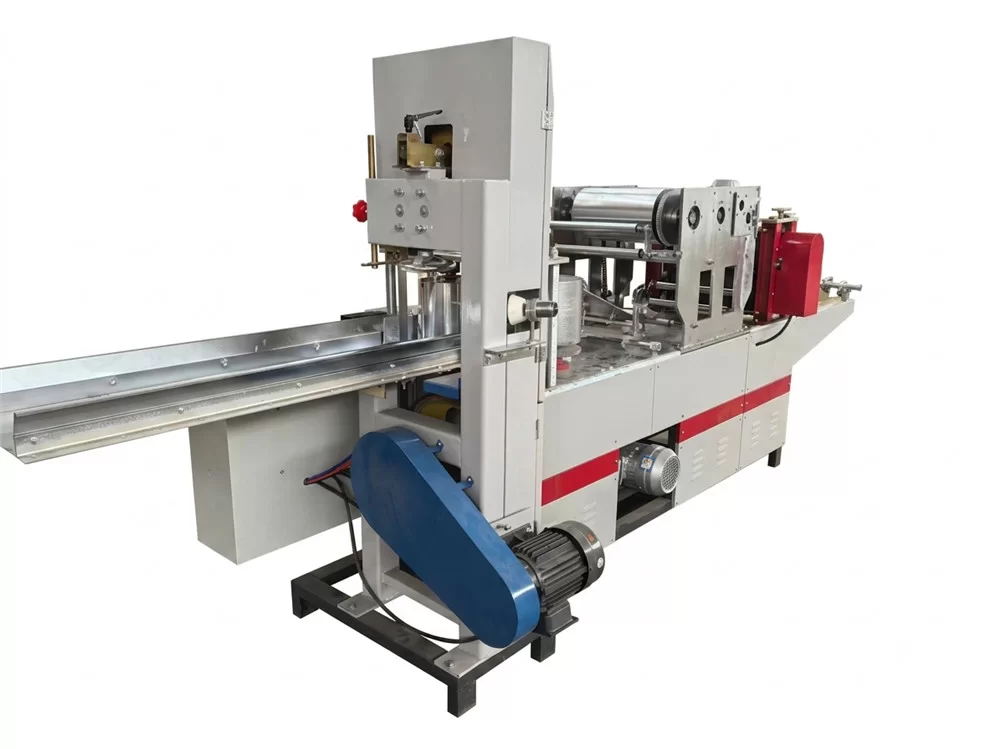
Function, configuration and line compatibility
Review how the machine works, what it can produce and which optional functions or supporting equipment may be needed for the complete process.
Machine overview and suitable production use
Printed Paper Napkin Production
The Model 300 two-color napkin paper machine is designed to convert jumbo tissue rolls into folded and counted paper napkins. With the corresponding printing and embossing configuration, the machine can produce restaurant napkins with logos, borders, decorative patterns and private-label designs.
The final equipment arrangement should be based on the napkin dimensions, fold, number of plies, printing colors, embossing pattern and packaging quantity.
Main Converting Functions
Jumbo tissue roll unwinding
Paper web alignment
One-color or two-color printing
Edge or full-width embossing
Longitudinal folding
Cross folding
Sheet counting
Finished-stack discharge
The exact functions included should be confirmed from the target napkin rather than treated as standard for every machine configuration.
Napkin Specifications to Confirm
Unfolded sheet dimensions
Finished folded dimensions
Fold arrangement
Number of plies
Paper basis weight
Number of printing colors
Embossing requirement
Sheets per stack or pack
Target output
Packaging format
The unfolded and folded dimensions should be stated separately. A product sample or dimensional drawing can help prevent misunderstandings about the fold structure.
Two-Color Printing
The printing section can be configured for two-color napkin designs. This is useful for restaurant logos, decorative borders, promotional designs and private-label products.
Printing performance depends on the paper surface, ink, artwork coverage, printing pressure, registration and operating speed.
Fine logos need suitable plate and registration control.
Large solid areas may require different ink and pressure settings.
The visible design position should be checked after folding.
Paper that absorbs ink unevenly may change the final appearance.
Approved artwork should be reviewed together with the fold position before printing cylinders or plates are prepared.
Embossing Options
Embossing can improve the appearance and apparent bulk of the napkin. Edge embossing can help hold multiple plies together, while full embossing produces a more visible surface pattern.
Customized embossing rollers can be manufactured for decorative or logo patterns. Excessive pressure should be avoided because it can affect softness, lightweight tissue strength and the appearance of printed areas.
Folding and Counting
After printing and embossing, the paper enters the folding section. The fold arrangement determines the finished napkin dimensions and visible presentation.
The counting system separates the output into defined stack quantities. Stable counting and orderly stack discharge are important when the napkins will enter automatic bag or box packing.
The first finished stack should be checked whenever the paper grade, napkin size, printing artwork, fold or stack quantity changes.
Raw Material Requirements
Napkin paper should have suitable softness, strength, fold stability and printing performance. Jumbo roll width, diameter, basis weight, number of plies, moisture and surface condition should be confirmed.
The paper used for machine testing should be reasonably representative of normal production material. A machine setting developed for one paper grade may need adjustment when the basis weight or surface properties change.
Packing Options
Finished napkins can be supplied in several ways:
Counted stacks in plastic bags
Printed retail packs
Dispenser refill packs
Boxed napkins
Individually wrapped napkins
Bulk inner bags and outer cartons
Manual or semi-automatic packing may suit frequent product changes and moderate output. Automatic packing is more practical when napkin dimensions and stack quantities remain stable.
Quality Checks
Unfolded and folded dimensions
Printing position and clarity
Color registration
Embossing appearance
Fold alignment
Sheet count
Stack shape
Package sealing
The printed design should remain readable after folding. Napkins should separate normally and should not stick together because of excessive ink or embossing pressure.
Information Required Before Configuration
Provide the jumbo roll specification, unfolded and folded napkin dimensions, fold arrangement, number of plies, paper basis weight, printing artwork, printing colors, embossing pattern, sheets per pack, required output and packaging method.
These details help determine the appropriate printing, embossing, folding, counting and packing configuration for the Model 300 napkin paper machine.
How the machine processes the material
The Model 300 two-color napkin paper machine converts a tissue jumbo roll into printed, embossed, folded and counted paper napkins. The production route can be adjusted according to the napkin size, folding arrangement, printing design and embossing requirement.
Jumbo Roll Unwinding
The tissue jumbo roll is installed on the unwind stand and the paper web is guided into the machine. The unwind tension is adjusted according to the tissue basis weight, softness, tensile strength and roll condition.
Stable tension helps maintain printing registration, embossing consistency and folding accuracy throughout production.
Two-Color Printing
The paper web passes through the first and second printing units when two-color printing is required. Each unit transfers one color of the approved pattern, logo or decorative design to the tissue surface.
The printing position, ink supply, plate pressure and color registration should be checked before continuous production. The visible design must also be inspected after folding because the final presentation differs from the flat paper web.
Embossing
After printing, the paper passes through the embossing unit. Edge embossing can help hold multiple plies together, while full embossing creates a broader surface texture.
Embossing pressure should match the tissue basis weight and printing design. Excessive pressure may damage the tissue or affect the appearance of the printed area.
Longitudinal and Cross Folding
The printed and embossed paper web enters the folding section. The machine first forms the required longitudinal fold and then completes the cross fold to produce the final napkin dimensions.
The folding components must match the unfolded size, folded size and specified folding arrangement. Product-size changes may require mechanical adjustment or replacement components.
Cutting and Counting
The folded paper is cut into individual napkins and counted electronically according to the required stack quantity. The finished napkins are discharged in orderly stacks for manual, semi-automatic or automatic packing.
The operator should check the unfolded dimensions, folded dimensions, printing position, embossing appearance, sheet count and stack shape whenever the paper grade or product specification changes.
Finished-Product Packing
The counted napkin stacks can be placed into plastic bags, printed retail packs, boxes or bulk inner packaging. Connected automatic packing is more suitable when the napkin dimensions and number of sheets per pack remain stable.
Machine data for configuration review
| Machine Model | Model 300 |
|---|---|
| Machine Type | Two-color printing, embossing and folding paper napkin machine |
| Suitable Raw Material | Jumbo tissue rolls suitable for paper napkin converting and printing |
| Suitable Finished Products | Restaurant table napkins, printed paper napkins, cocktail napkins, lunch napkins and selected dispenser napkins |
| Effective Working Width | Insert the verified working width from the machine technical specification |
| Unfolded Napkin Size | Confirm according to the selected Model 300 configuration |
| Finished Folded Size | Confirm according to the required folding arrangement |
| Number of Plies | Confirm according to the product specification and raw material |
| Printing System | One-color or two-color printing according to configuration |
| Printing Artwork | Custom logo, border or decorative design based on approved artwork |
| Embossing System | Edge embossing, full embossing or customized embossing according to configuration |
| Folding Method | Confirm according to the required napkin dimensions and fold arrangement |
| Counting System | Electronic counting |
| Design Speed | Insert the verified design speed in sheets per minute |
| Reference Output | Confirm according to the napkin dimensions, paper basis weight, number of plies, printing coverage and continuous operating conditions |
| Total Power | Insert the total installed power for the selected printing and embossing configuration |
| Overall Dimensions | Insert the verified length × width × height of the final machine |
| Supporting Equipment | Napkin stack-transfer system, bag packing machine, box packing machine, individual wrapping equipment and carton packing equipment |
Printing coverage, ink characteristics and paper absorption can affect the practical operating speed. Reference output should therefore be stated together with the napkin size, paper grade, printing design and pack quantity.
Functions available by requirement
Machines used before or after this process
Design speed and reference output are not the same value. Practical production depends on raw material, finished-product dimensions, machine configuration, operator preparation and the capacity of connected equipment.