
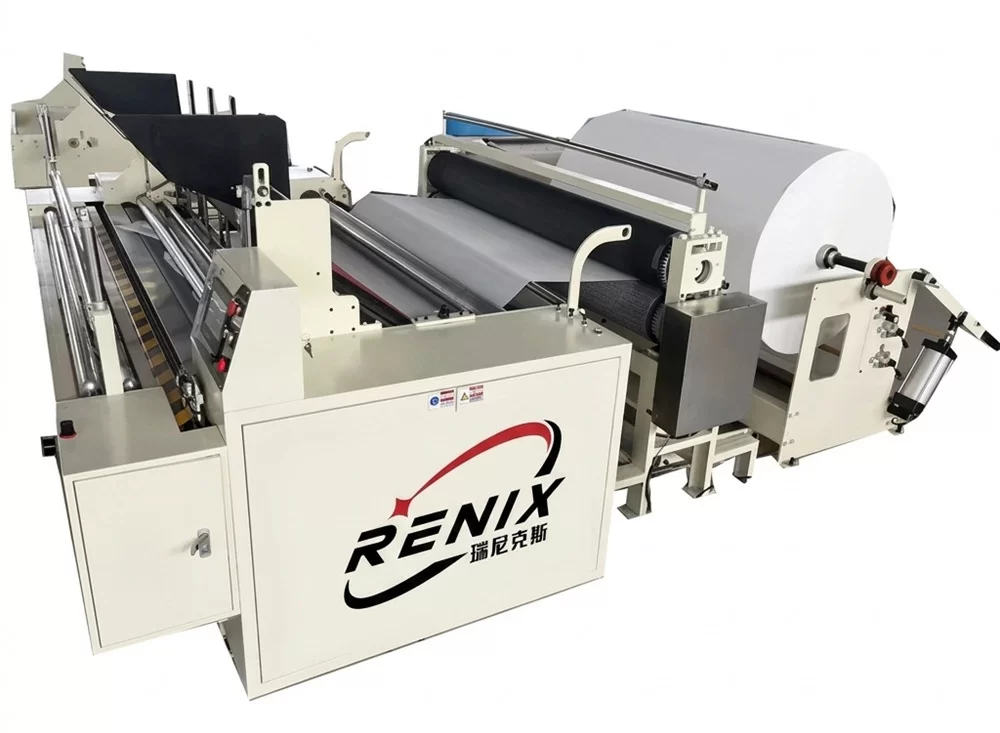
Function, configuration and line compatibility
Review how the machine works, what it can produce and which optional functions or supporting equipment may be needed for the complete process.
Machine overview and suitable production use
Toilet Paper Rewinding for Flexible Roll Production
The 2200 toilet paper rewinding machine converts jumbo tissue rolls into long perforated paper logs ready for cutting and packing. The machine is suitable for factories producing standard toilet rolls in different diameters, core sizes, ply structures and retail pack formats.
A 2200 mm working width provides a practical basis for common jumbo tissue rolls, but the final unwind arrangement should always be confirmed from the raw material available to the customer. Jumbo roll width, diameter, basis weight, number of plies and paper strength can all affect machine configuration and practical output.
Main Converting Operations
Depending on the selected configuration, the rewinding machine can complete several converting operations in one production cycle:
Jumbo roll unwinding
Paper web guidance and tension control
Multi-ply paper combination
Edge, full-width or laminated embossing
Sheet perforation
Automatic core feeding
Cored or coreless rewinding
Paper log formation
Finished log discharge
The functions included in the final machine should be selected according to the finished toilet roll rather than added without a defined production requirement.
Finished Product Information to Confirm
Before the rewinder is manufactured, the buyer should provide the main finished-roll specifications:
Finished-roll width
Finished-roll diameter
Core diameter or coreless requirement
Number of plies
Paper basis weight
Perforation length
Number of sheets per roll
Embossing requirement
Expected retail pack quantity
Roll diameter and sheet count affect the amount of paper in each finished log. Core size influences the core-feeding and rewinding arrangement. Perforation length determines the sheet format and must match the target market.
Embossing Options
The rewinding machine can be configured with different embossing systems. Edge embossing can help hold multiple plies together, while full-width embossing changes the appearance and apparent bulk of the finished tissue.
Laminated embossing can be considered when the product requires more defined ply bonding or a specific surface pattern. Glue application, roller pressure and pattern registration must be matched to the paper.
Customized embossing rollers should be manufactured from an approved drawing or finished-product sample. The effective embossing width and required pattern position should be confirmed before production.
Cored and Coreless Rewinding
Cored toilet rolls use cardboard tubes to support the finished roll. The machine can be equipped with automatic core feeding when the core dimensions and production rhythm are stable.
Coreless rolls require a different initial winding method. The center must remain stable enough for cutting, packing and dispensing without a conventional cardboard tube.
If both formats are required, the changeover procedure and necessary components should be confirmed in advance. A standard cored rewinding system should not be assumed to produce coreless products without the corresponding configuration.
Understanding Speed and Output
The design speed is a machine reference rather than a guaranteed finished-roll output under every production condition. Practical output can vary with paper quality, roll diameter, sheet count, number of plies, embossing, operator preparation and downstream cutting and packing capacity.
The buyer should ask for the basis used to calculate production:
Raw material specification
Finished-roll dimensions
Number of sheets per roll
Continuous operating speed
Log cutting capacity
Packing capacity
A high rewinding speed cannot increase finished-pack output if the log saw or packing section becomes the production bottleneck.
Supporting Equipment
The rewinding machine produces long paper logs rather than fully packed retail rolls. Downstream equipment is selected according to the required automation level.
A band saw can support lower-output, operator-assisted cutting.
An automatic log saw supports repeated cutting and more consistent roll widths.
An individual wrapping machine protects single rolls.
A multi-roll packing machine counts and packs several rolls together.
Bundle or carton equipment can support secondary packaging.
The discharge direction and transfer height should be reviewed when the machines will be connected by conveyors.
Information Required for Configuration
To prepare an accurate proposal, provide the jumbo roll specification, finished-roll dimensions, embossing pattern, perforation length, core requirement, target output, packaging format, workshop dimensions and destination power conditions.
A finished toilet roll sample or complete product drawing can reduce uncertainty and help match the rewinding, cutting and packing equipment to the actual production requirement.
How the machine processes the material
The 2200 toilet paper rewinding machine converts jumbo tissue rolls into long perforated paper logs through continuous unwinding, embossing, perforating and rewinding operations. The exact process depends on whether the finished product uses a paper core or a coreless structure.
Jumbo Roll Unwinding
Jumbo tissue rolls are installed on the unwind stands. The paper webs are drawn into the machine under controlled tension and combined according to the required number of plies. Stable unwinding helps reduce web deviation, wrinkles and uneven feeding.
Embossing and Ply Combination
The combined paper web passes through the selected embossing unit. Edge embossing can help hold multiple plies together, while full-width or laminated embossing can change the surface pattern, apparent bulk and finished-roll presentation.
Embossing pressure should be adjusted according to the paper basis weight, softness, number of plies and pattern depth. Excessive pressure may damage lightweight tissue or reduce the expected softness.
Perforation
The paper web then enters the perforating section. The perforating roller creates controlled tear lines at the specified sheet interval. Perforation length should be confirmed from the finished toilet roll rather than selected only from a standard machine setting.
Core Feeding or Coreless Winding
For cored toilet paper, prepared cardboard tubes are fed into the rewinding section manually or automatically according to the selected configuration. The paper is attached to the core and rewound to the preset diameter or sheet count.
Coreless toilet rolls use a different initial winding arrangement. The machine must form a stable roll center without a conventional cardboard tube. Coreless production therefore requires the corresponding rewinding components and operating settings.
Paper Log Formation and Discharge
When the preset roll diameter or paper length is reached, the rewinding cycle is completed and the long paper log is discharged. Depending on the configuration, tail sealing can be completed before the log leaves the machine.
The finished paper log is transferred to a band saw or automatic log saw for cutting into individual toilet rolls. The cut rolls can then enter individual wrapping, multi-roll packing or bundle-packing equipment.
Machine data for configuration review
| Machine Model | 2200 Toilet Paper Rewinding Machine |
|---|---|
| Effective Working Width | 2200 mm |
| Suitable Raw Material | Jumbo tissue rolls suitable for toilet paper converting |
| Suitable Finished Products | Cored toilet paper rolls, coreless toilet paper rolls and selected kitchen towel rolls within the confirmed configuration |
| Number of Plies | Confirm according to the finished product and raw material |
| Finished-Roll Diameter | Confirm according to the required toilet roll specification |
| Core Diameter | Confirm according to the cardboard tube or dispenser specification |
| Perforation Length | Adjustable within the confirmed machine configuration |
| Embossing System | Edge embossing, full-width embossing or laminated embossing according to configuration |
| Design Speed | Insert the verified design speed from the final technical proposal |
| Reference Output | Confirm according to the paper grade, number of plies, roll diameter, sheet count and continuous operating conditions |
| Total Power | Insert the total installed power for the selected configuration |
| Overall Dimensions | Insert the verified length × width × height of the final machine |
| Power Supply | Customized according to the destination voltage and frequency |
| Supporting Equipment | Band saw, automatic log saw, individual roll wrapper, multi-roll packing machine and bundle packing machine |
Design speed and reference output should not be treated as the same value. Practical production depends on the raw material, finished-roll specification, machine functions, operator preparation and downstream cutting and packing capacity.
Functions available by requirement
Machines used before or after this process
Design speed and reference output are not the same value. Practical production depends on raw material, finished-product dimensions, machine configuration, operator preparation and the capacity of connected equipment.