
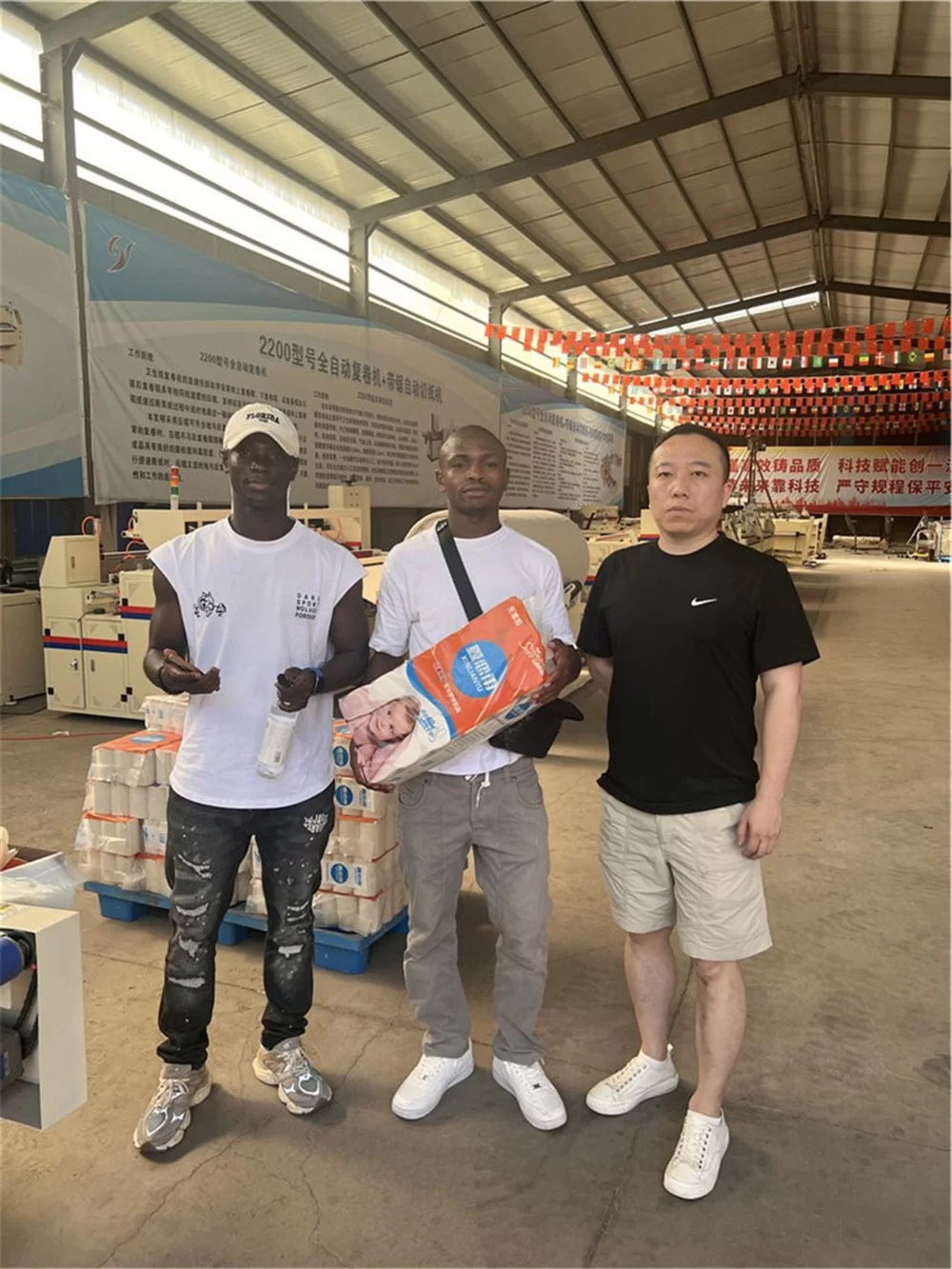
Renix regularly receives international customers who want to inspect tissue paper converting equipment before selecting an individual machine or planning a complete production system. The photographs used with this article record several workshop visits rather than one single project. During the visits, customers viewed machine structures, paper feeding sections, production areas and finished tissue products inside the factory.
Reviewing Equipment in the Workshop
A workshop visit gives customers a direct view of machine frames, rollers, transmission components, web paths and operating positions. Equipment with similar names may perform different operations, so the function of each unit should be confirmed before a configuration is selected.
During the inspection, customers can compare a toilet paper rewinding machine with a facial tissue folding machine. The first processes jumbo tissue rolls into paper logs through rewinding, embossing and perforation, while the second forms interfolded tissue stacks. Cutting and packing are normally completed by separate downstream equipment.
Checking Material Feeding and Product Transfer
The correct machine configuration depends on jumbo-roll width, diameter, basis weight, number of plies and the required finished product. Customers can review the unwind position, roller arrangement, processing section and discharge direction. When several machines will be connected, conveyor height, product orientation, buffer capacity and control signals must also be considered.
Seeing these sections in the workshop helps customers understand which operations are included in the main machine and which require additional cutting, conveying or packing equipment.
Discussing the Intended Finished Product
Machine selection should begin with the product the customer plans to manufacture. Toilet rolls, facial tissues, kitchen towels, paper napkins and folded hand towels require different processing methods. Product dimensions, fold type, roll diameter, sheet count, embossing and retail packing format all influence the final proposal.
Samples, photographs and specification sheets are useful during a factory visit because they turn a general equipment discussion into a measurable production target.
Information Needed for a Technical Proposal
Type of tissue product to be manufactured
Jumbo-roll width, diameter and basis weight
Finished sheet size or finished-roll diameter
Number of plies, folding format or perforation length
Required production speed and daily output
Individual or multi-pack packing format
Workshop dimensions and local electrical standard
After these details are confirmed, the main machine, downstream equipment, workshop layout and automation scope can be evaluated more accurately. A factory visit therefore provides a practical step between the initial inquiry and a detailed technical configuration.
Published by
Zhengzhou Renix Machinery Co., Ltd.
This update is prepared from company production, inspection, testing or delivery records. Equipment details should be read together with the confirmed project configuration.
Copyright © Zhengzhou Renix Machinery Co., Ltd.. Original text and photographs may not be reproduced for commercial use without written permission. Quotations must identify the source and link to the original page.