
Process, equipment connection and operating requirements
Review how the complete line is arranged, which finished products it supports, how packaging is handled and what factory conditions should be confirmed.
Production process and equipment connection
A fully automatic toilet paper production line connects the principal converting, cutting, conveying and packaging stages required to turn jumbo tissue rolls into packed toilet paper rolls.
Instead of operating the rewinder, log saw and packing machines as separate production islands, the connected line transfers products between the main processes in a planned sequence. This reduces repeated manual handling and makes it easier to coordinate practical output across the complete production route.
The line can be configured for different toilet roll diameters, sheet counts, paper plies, embossing patterns, core specifications and retail pack formats. The final equipment combination should be selected from the actual finished product and production conditions rather than from the maximum speed of one machine.
Suitable Finished Products
The production line can be configured for products such as:
Standard household toilet paper rolls
Embossed toilet paper rolls
Laminated multi-ply toilet rolls
Toilet paper rolls with cardboard cores
Coreless toilet paper rolls
Compact commercial toilet rolls
Individually wrapped toilet rolls
Multi-roll retail packs
Bundled toilet paper packs
Different finished products may require different rewinding, core-feeding, embossing, sealing, cutting and packing functions.
A line intended for standard core rolls should not automatically be described as suitable for coreless products unless the corresponding rewinding and discharge configuration has been included.
Complete Production Process
A typical automatic production route includes the following stages:
1. Jumbo Roll Unwinding
Jumbo tissue rolls are installed on the unwind stands and fed into the converting section.
The unwind configuration is selected according to:
Raw paper width
Jumbo roll diameter
Number of paper plies
Basis weight
Available lifting method
Web tension requirements
Normal roll replacement procedure
Pneumatic or shaftless loading can be considered depending on the roll weight and selected machine configuration.
2. Embossing and Ply Combination
The paper webs can pass through embossing units before rewinding.
Available configurations may include:
Steel-to-rubber embossing
Steel-to-steel embossing
Edge embossing
Full-width embossing
Ply lamination
Glue lamination
Custom embossing patterns
The embossing configuration affects product appearance, roll firmness, bulk, absorbency and the practical speed of the line.
3. Perforating and Rewinding
The rewinder perforates the paper and rewinds the web into toilet paper logs.
The machine controls the main product parameters, including:
Perforation length
Sheet count
Log diameter
Paper tightness
Core specification
Tail sealing
Product discharge
The rewinder working width should be selected from the jumbo roll width and the planned number of finished rolls across the web.
4. Log Transfer
Finished toilet paper logs are transferred from the rewinder to the cutting section.
Depending on the selected automation level, the transfer system can include:
Automatic log discharge
Log accumulation
Conveyor transfer
Product positioning
Cutting-machine feeding
Fault or blockage detection
A controlled transfer system helps reduce manual movement between the rewinder and log saw.
5. Automatic Log Cutting
The automatic log saw cuts the long toilet paper logs into finished rolls.
The cutting section should be matched to:
Finished roll width
Log diameter
Core or coreless structure
Cutting accuracy
Rewinder discharge rhythm
Packing-machine feeding requirements
A high rewinding speed does not guarantee the same number of finished rolls at the end of the line. The log saw must be able to process the specified roll width and diameter at a compatible practical rate.
6. Roll Conveying and Inspection
Cut rolls are transferred toward the packing section.
The conveyor arrangement may include:
Roll separation
Orientation control
Counting
Accumulation
Product rejection
Metal detection or inspection options
Automatic feeding into the packing machine
The required functions depend on the selected packaging format and the level of product inspection.
7. Primary Packaging
Finished toilet rolls can be packed through different primary packaging methods.
Typical options include:
Individual roll wrapping
Two-roll packs
Four-roll packs
Six-roll packs
Eight-roll packs
Ten-roll packs
Twelve-roll packs
Customized multi-roll arrangements
The packing machine must be selected from the actual roll diameter, roll width, pack arrangement, film specification and required sealing method.
8. Secondary Packing and Finished-Product Handling
After primary packing, products can be grouped or prepared for warehouse handling.
Optional downstream equipment may include:
Bundle packing machines
Bagging machines
Carton packing equipment
Carton sealing machines
Finished-product conveyors
Checkweighing equipment
Coding and labeling systems
Pallet collection areas
Secondary packing should be confirmed separately because retail pack output and bundle or carton output are not necessarily the same.
Main Equipment in the Line
A fully automatic toilet paper production line can include:
Jumbo roll unwind stands
Automatic toilet paper rewinding machine
Embossing and lamination units
Automatic core feeding system
Tail sealing system
Log discharge and transfer conveyors
Automatic log saw cutting machine
Finished-roll conveyor system
Individual roll packing machine
Multi-roll bag packing machine
Bundle packing equipment
Coding, labeling or inspection equipment
Electrical control cabinets
Production line safety guards
Not every project requires every machine listed above. The appropriate supply scope depends on the finished product, packaging method, existing equipment and investment plan.
Automation Scope
“Fully automatic” should describe the connection of the main production stages, not the complete removal of all human work.
The connected line can automate operations such as:
Paper web control
Perforating
Rewinding
Log discharge
Log conveying
Automatic cutting
Roll transfer
Product counting
Packing-machine feeding
Primary packing
Pack discharge
Operators may still be required for:
Jumbo roll replacement
Cardboard core replenishment
Film and bag replenishment
Glue preparation
Product inspection
Machine setup
Specification changeover
Cleaning
Fault handling
Blade inspection
Preventive maintenance
Finished-product collection
The number of operators should therefore be confirmed from the actual material-handling and packaging arrangement.
Practical Output
The production capacity of a complete toilet paper line should not be determined from the rewinder design speed alone.
Practical finished-product output is affected by:
Raw paper quality
Number of plies
Paper basis weight
Finished roll diameter
Finished roll width
Sheet count
Perforation length
Embossing depth
Lamination method
Core or coreless configuration
Log saw capacity
Pack quantity
Film specification
Packing-machine speed
Product changeover
Normal operating efficiency
The slowest connected process may determine the practical output of the complete line.
For this reason, a useful production proposal should state the product specification used for the output calculation. A general claim such as “maximum rolls per minute” has limited value if the roll size, paper construction and pack format are not defined.
Optional Functions
The production line can be reviewed with optional functions such as:
Pneumatic jumbo roll loading
Automatic web guiding
Constant web tension control
Multiple embossing units
Glue lamination
Edge embossing
Full embossing
Automatic core feeding
Coreless rewinding
Automatic tail sealing
Automatic log accumulation
Servo log saw
Automatic roll counting
Individual roll wrapping
Multi-roll bag packing
Bundle packing
Date coding
Labeling
Product inspection
Remote fault diagnosis
Optional functions should be selected only when they support a defined product or production requirement. Adding functions without confirming the finished product can increase cost and make operation unnecessarily complex.
Raw Material Requirements
The line can process suitable jumbo tissue rolls made from materials such as virgin pulp tissue, recycled tissue or an agreed mixed-pulp grade.
Before confirming the equipment, provide:
Jumbo roll width
Jumbo roll diameter
Core diameter
Paper basis weight
Number of plies
Paper tensile strength
Moisture condition
Surface condition
Material sample, if available
Actual operating stability depends on the consistency of the raw paper. Large variations in tension, moisture, strength or thickness can affect rewinding, perforation, embossing, cutting and packing.
Factory and Utility Requirements
The production line layout should be reviewed before the machines are manufactured or shipped.
Important factory information includes:
Internal workshop length and width
Clear ceiling height
Door dimensions
Column positions
Raw-material storage area
Packaging-material storage area
Finished-product collection area
Maintenance access
Operator passages
Electrical supply
Voltage and frequency
Compressed-air availability
Vacuum requirements
Ventilation conditions
Loading and unloading route
The line should not be arranged only according to the external dimensions of the machines. Space is also required for roll replacement, blade maintenance, film replenishment, cabinet access and product handling.
Line Control and Equipment Connection
A connected automatic line requires more than placing several machines beside each other.
The equipment interfaces should confirm:
Product flow direction
Infeed and discharge height
Conveyor width
Product accumulation
Capacity balance
Start and stop sequence
Fault interlocking
Emergency stop connection
Sensor positions
Control signals
Changeover procedure
The line control system can use PLC and touch-screen operation for production settings, status monitoring, alarms and fault information. The exact control scope depends on the supplied machines and the required level of integration.
Quality Checks Before Shipment
Before shipment, the agreed equipment configuration can be checked through:
Mechanical assembly inspection
Fastener and transmission inspection
Electrical cabinet inspection
Sensor and safety-device checks
Empty-machine operation
Material trial operation
Perforation inspection
Embossing inspection
Roll diameter verification
Cutting-quality inspection
Packing-format verification
Conveyor and signal testing
Equipment cleaning
Packing checklist review
Where possible, the trial material should be close to the customer’s planned jumbo tissue specification.
How to Request a Suitable Configuration
To prepare a relevant fully automatic toilet paper production line proposal, provide:
Finished toilet roll sample or drawing
Roll width and diameter
Number of plies
Basis weight
Sheet count or perforation length
Core diameter or coreless requirement
Embossing requirement
Jumbo roll width and diameter
Required practical output
Individual or multi-roll pack format
Secondary packing requirement
Available operators
Workshop drawing
Destination voltage and frequency
Existing equipment, if applicable
This information helps define the rewinder width, cutting system, conveyor arrangement, packing equipment, automation scope and factory layout.
Configuration Note
The specifications of a fully automatic toilet paper production line should be confirmed for each project.
Published machine speeds and reference output figures are selection references, not guaranteed finished-product output under every raw material, roll specification and packaging format. The final production capacity, installed power, operator requirement, equipment arrangement and workshop space should be stated in the confirmed technical proposal.
Primary and secondary packing options
Equipment arrangement and workshop flow
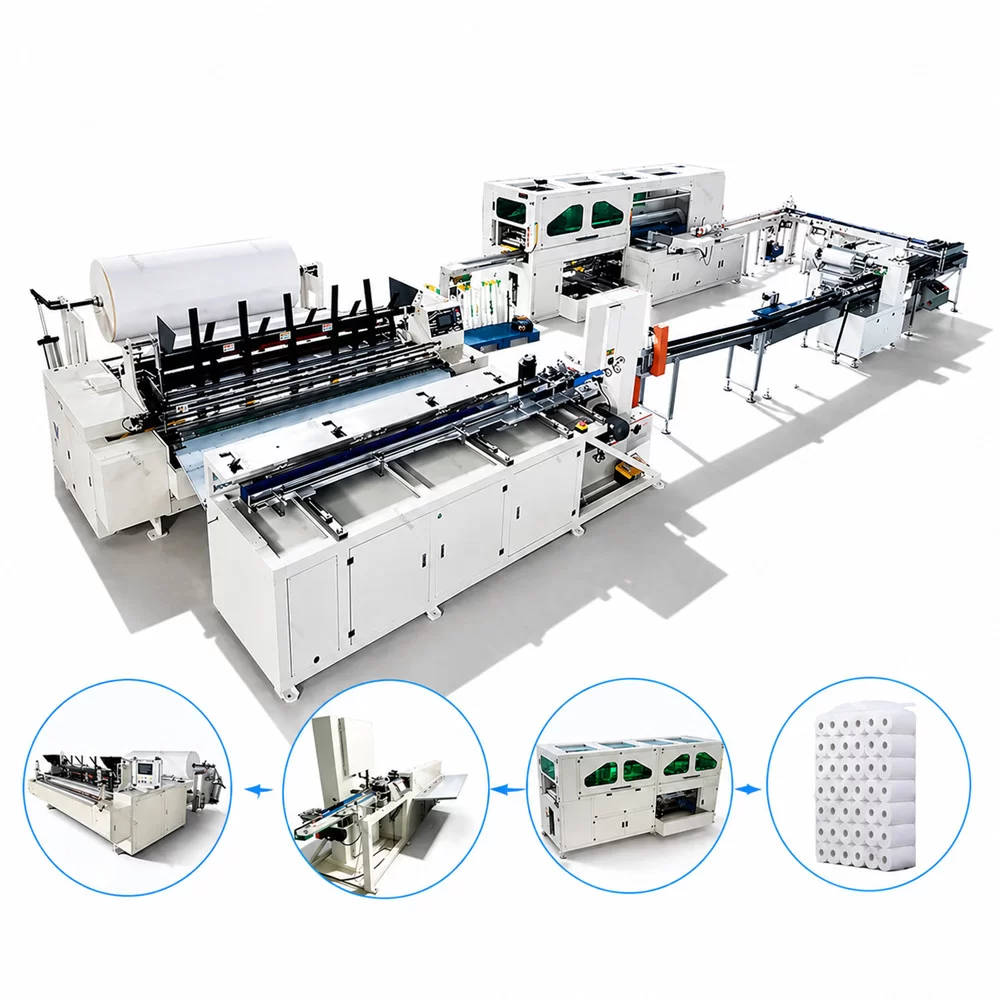
Practical output, operator quantity, installed power and workshop space depend on the final equipment combination, finished-product dimensions, packing format and operating conditions. Confirm these values in the final technical proposal.