
Process, equipment connection and operating requirements
Review how the complete line is arranged, which finished products it supports, how packaging is handled and what factory conditions should be confirmed.
Production process and equipment connection
The Fully Automatic Facial Tissue Production Line converts jumbo tissue rolls into folded, cut and packed facial tissue products through one connected production process. The line can combine jumbo roll feeding, web tension control, embossing, interfolding, tissue log accumulation, automatic cutting, single-pack wrapping and multi-pack bundling.
The production line is available with 4, 6, 8, 10, 12 or 14 folding lanes. The suitable configuration depends on the required tissue width, unfolded sheet size, folded size, sheets per pack, target output and packaging method.
High-speed automatic facial tissue lines can reach a main-machine speed of approximately 200 m/min. Complete configurations may include a multi-lane folding machine, tissue log accumulator, automatic log saw, servo-controlled single-pack wrapper, bundling machine and automatic case packer. Finished output can reach approximately 200 packs per minute on suitable high-speed configurations. 【1-755d47】【2-8ff78b】
Suitable Finished Products
V-fold facial tissues
Interfolded facial tissues
Soft-pack facial tissues
Boxed facial tissues
Bottom-draw tissues
Two-ply and three-ply facial tissues
Embossed facial tissues
Edge-embossed tissue packs
Single soft packs
Multi-pack tissue bundles
The folding format, sheet size and tissue count must be confirmed before selecting the number of lanes and the cutting and packing equipment. Boxed tissues, soft packs and bottom-draw tissues may require different folding, discharge and packaging configurations.
Reference Technical Parameters
Folding lanes: 4 to 14 lanes
Jumbo roll width: approximately 840 to 2800 mm
Maximum jumbo roll diameter: approximately 1100 to 1500 mm
Jumbo roll core diameter: 76.2 mm
Paper plies: 2 to 3 plies
Paper basis weight: approximately 13 to 22 g/m² per ply
Practical folding speed: 120 to 200 m/min
Unfolded sheet width: approximately 180 to 230 mm
Unfolded sheet length: approximately 160 to 230 mm
Folded tissue width: approximately 90 to 115 mm
Sheets per pack: commonly 50 to 200 sheets
Finished output: approximately 80 to 200 packs/min
Installed power: approximately 75 to 130 kW
Operators: 4 to 7 people per shift
Compressed-air pressure: 0.6 to 0.8 MPa
Comparable fully automatic facial tissue lines use jumbo roll widths up to approximately 2800 mm. Published configurations include operating speeds around 120 cuts per minute for automatic tissue log cutting and packing speeds of approximately 30 to 60 bags per minute for an individual packing machine. Higher-output multi-lane systems can use several packing channels to increase total line capacity. 【1-755d47】【3-d88c4a】
Production Process
Jumbo Roll Feeding
Two or three jumbo tissue rolls are installed on the unwind stands according to the required number of plies. Pneumatic loading, independent tension adjustment and automatic web guiding can be included to improve feeding stability.
The raw paper should have consistent basis weight, moisture and tensile strength. Uneven paper tension can affect folding accuracy, tissue alignment and production stability.
Embossing and Ply Combination
The paper passes through the embossing section before folding. Available configurations include full embossing, edge embossing and customized patterns.
Edge embossing helps hold two or three plies together. The embossing pressure must be adjusted according to the paper strength and required product appearance to avoid tearing or excessive compression.
Interfolding
The folding machine cuts and interfolds the paper into continuous tissue stacks. Vacuum adsorption, folding rollers and servo-controlled systems coordinate the paper to produce consistent sheet dimensions and overlapping folds.
The folding section can monitor paper breaks and stop automatically when abnormal feeding is detected. The number of folding lanes determines the production width and has a direct effect on total output.
Tissue Log Accumulation
Completed tissue logs are transferred from the folding machine to an accumulator. The accumulator provides a buffer between the folding and cutting sections and distributes tissue logs to the automatic log saw.
A suitable accumulation system allows the folding machine to continue running during brief cutting or packing interruptions, reducing unnecessary line stops.
Automatic Log Cutting
The automatic log saw divides the long facial tissue logs into individual tissue packs. A servo feeding system controls the cutting length, while automatic blade grinding helps maintain cutting quality during continuous operation.
Reference cutting speed is approximately 100 to 200 cuts per minute, depending on the number of cutting channels, tissue log dimensions and selected machine. Published multi-lane cutters include stable speeds of approximately 120 to 200 cuts per minute. 【1-755d47】
Single-Pack Wrapping
Cut tissue stacks are automatically transferred to the single-pack wrapping machine. The machine completes product positioning, film feeding, forming, sealing and finished-pack discharge.
The wrapper is selected according to the folded tissue dimensions, pack height, sheets per pack and packaging film. Common outputs range from 30 to 100 packs per minute per packing channel, while high-speed multi-machine configurations can provide a higher total production-line output.
Multi-Pack Bundling
Individual tissue packs can be grouped into multi-pack bundles for wholesale, retail or e-commerce distribution. The bundling machine counts the soft packs, arranges the required quantity and seals the outer package.
Common bundle arrangements include 3, 4, 6, 8, 10 or 12 individual packs. The final bundle specification determines the grouping system, bag dimensions and bundling speed.
Main Equipment
Two or three jumbo roll unwind stands
Automatic web-guiding and tension-control system
Embossing and edge-embossing units
Multi-lane facial tissue folding machine
Vacuum system
Automatic tissue log accumulator
Multi-lane automatic log saw
Tissue stack transfer conveyors
Full-servo single-pack wrapping machine
Automatic multi-pack bundling machine
Finished-pack discharge conveyor
PLC control cabinets
Safety guards and interlocking devices
Optional equipment can include automatic box packing, carton erecting, carton sealing, checkweighing, coding, labeling and robotic palletizing systems.
Automation and Operators
The production line can automatically perform paper feeding, tension control, embossing, folding, tissue log transfer, accumulation, log cutting, product conveying, single-pack wrapping, pack counting and bundling.
The line normally requires 4 to 7 operators per shift. Personnel are still needed for jumbo roll replacement, film and bag replenishment, product inspection, specification changeover, blade inspection, cleaning, fault handling and finished-product collection.
A line producing one stable soft-pack specification may operate with four or five people. A configuration with several wrappers, bundling, case packing or frequent product changes may require six or seven people.
Installed Power and Utilities
The connected production line normally requires approximately 75 to 130 kW of installed power. A small 4-lane or 6-lane arrangement uses less power, while a 10-lane to 14-lane line with several wrappers, bundling and automatic carton handling requires a larger electrical supply.
Recommended factory electrical capacity is approximately 130 to 200 kVA. The final value should include the folding machine, vacuum system, log saw, conveyors, wrappers, bundling equipment, air compressor and workshop auxiliary systems.
Compressed-air pressure should normally be maintained at 0.6 to 0.8 MPa. Approximate air consumption is 2.0 to 4.0 m³/min, depending on the cutting and packing configuration.
Workshop Requirements
The production line usually requires an installation footprint of approximately 35 to 50 m long and 10 to 15 m wide. A total workshop area of 700 to 1200 m² is recommended for equipment installation, jumbo roll storage, packaging materials, finished products, maintenance access and operator passages.
The final layout should consider the number of folding lanes, tissue log distribution, quantity of packing machines, bundle direction, doors, columns and the movement of raw materials and finished products.
Information Required for Configuration
Before confirming the production line, provide the unfolded tissue size, folded size, number of plies, paper basis weight, sheets per pack, soft-pack dimensions, required packs per minute, number of packs per bundle, packaging film, jumbo roll dimensions, workshop drawing and destination voltage.
The final number of folding lanes, cutting channels, individual packing machines and bundling equipment will be selected according to the required finished-product output and packaging specification.
Configuration Note
The reference output of 80 to 200 packs per minute represents a configurable range rather than the guaranteed output of every facial tissue line. Practical capacity depends on the number of lanes, sheet size, sheets per pack, tissue log cutting capacity, number of packing channels and bundle format.
The final installed power, operator quantity, line dimensions and production capacity should be stated in the confirmed technical proposal.
Primary and secondary packing options
Equipment arrangement and workshop flow
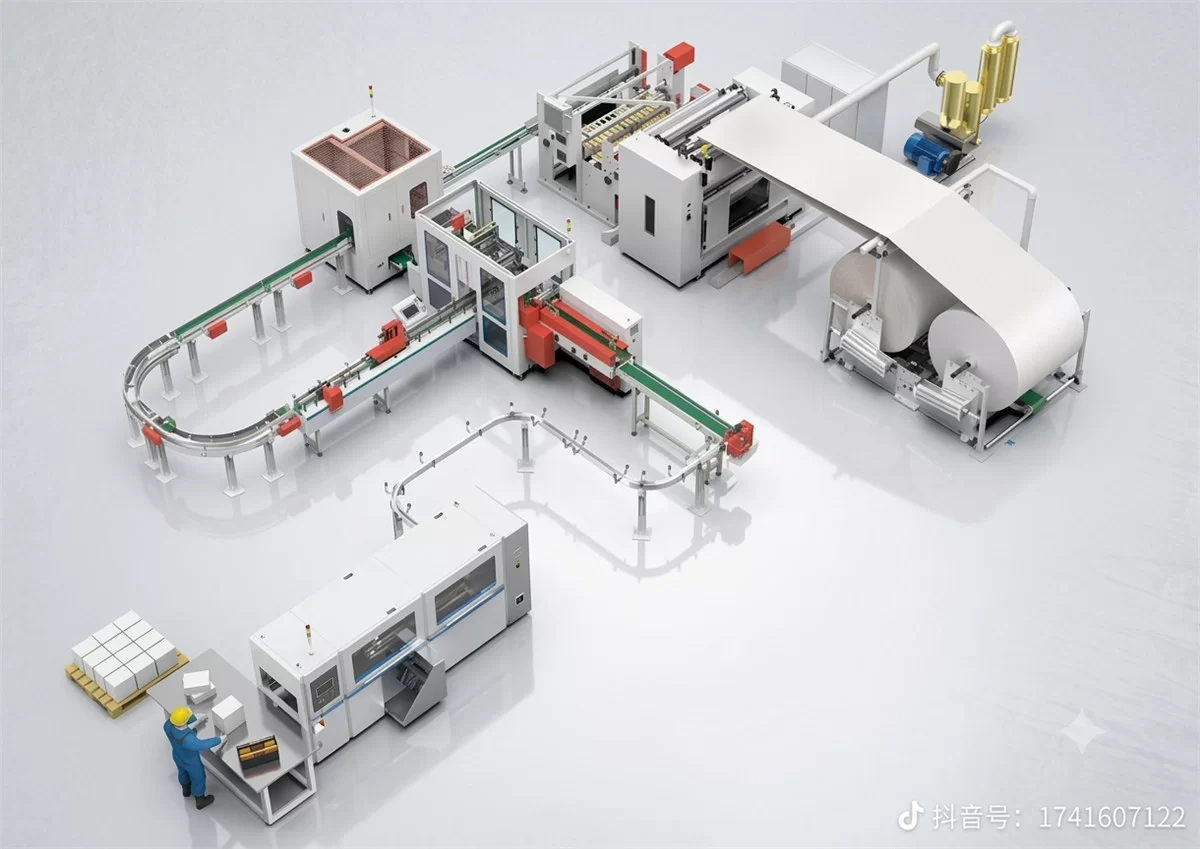
Practical output, operator quantity, installed power and workshop space depend on the final equipment combination, finished-product dimensions, packing format and operating conditions. Confirm these values in the final technical proposal.