
Function, configuration and line compatibility
Review how the machine works, what it can produce and which optional functions or supporting equipment may be needed for the complete process.
Machine overview and suitable production use
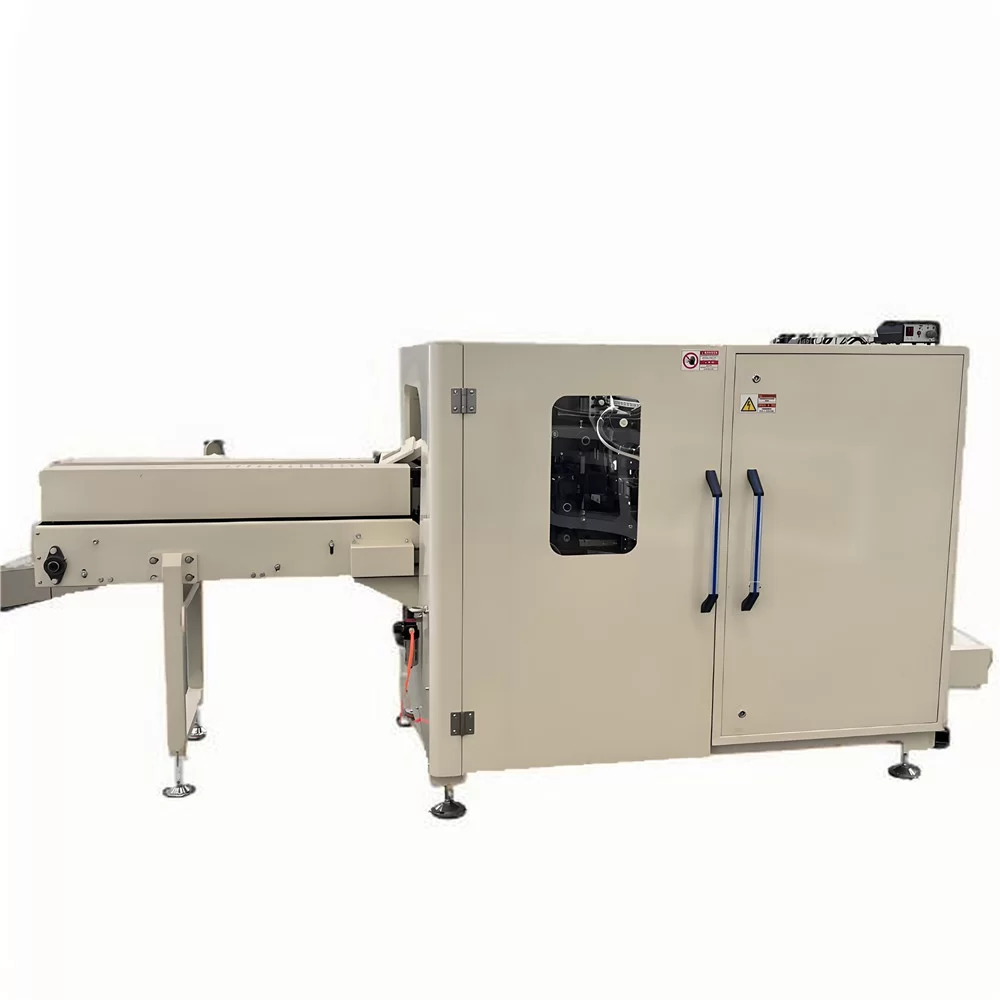
Automatic Rotary Facial Tissue Log Saw
The Automatic Rotary Facial Tissue Log Saw is a downstream cutting machine for facial tissue converting lines. It receives long interfolded tissue logs from the folding machine and cuts them into individual stacks prepared for soft-pack wrapping or box packing.
This machine performs cross cutting only. It does not unwind jumbo rolls, interfold tissue sheets or wrap finished packs. The folding machine, cutter, transfer system and packing machine must be selected around the same tissue-log and finished-pack dimensions.
Suitable Products
V-fold facial tissue logs
Interfolded facial tissue stacks
Soft-pack facial tissue stacks
Box facial tissue stacks within the confirmed cutting range
Working Process
The folded tissue log enters the feeding section and is positioned by the controlled conveyor or servo feeding mechanism. The rotary blade completes continuous cross cutting according to the preset stack length. Head and tail waste can be separated according to the selected configuration, and accepted stacks are discharged toward the next conveyor or packing machine.
Configuration and Line Matching
Final cutting range, speed, installed power and machine dimensions must be confirmed from the tissue-log width, height and length, the finished stack dimensions, tissue softness, number of plies, sheets per pack and required output. Quoted speed should be based on representative paper and the approved product specification rather than an unloaded demonstration.
Information Required Before Configuration
Tissue-log width, height and length
Finished stack dimensions
Number of plies and paper basis weight
Sheets per retail pack
Required cutting capacity
Upstream folding-machine output
Downstream packing-machine infeed height and direction
Destination voltage and compressed-air conditions
Equipment Boundary
This page describes an individual facial tissue cutting machine, not a complete production line. Folding, product transfer, soft-pack wrapping, box packing and secondary bundling require separate equipment unless explicitly included in the confirmed proposal.
Upstream Connection
The rotary log saw is installed after a facial tissue folding machine and cuts continuous tissue logs into the required stack length. Log height, sheet count, conveyor level and cutting pitch must match the upstream output.
How the machine processes the material
The feeding system positions the long interfolded tissue log and transfers it through the cutting area. A continuously rotating blade cuts the log into individual stacks at the required length. The discharge section then transfers accepted stacks to manual collection or a connected packing machine.
Machine data for configuration review
Machine type | Automatic rotary facial tissue log saw |
Applicable material | Interfolded facial tissue logs |
Cutting method | Continuous rotary cross cutting |
Product range | Confirmed according to the tissue log and finished stack |
Design speed | Confirmed according to the approved product specification |
Installed power | Confirmed in the technical agreement |
Utilities | Voltage and compressed air confirmed for the destination |
Dimensions | Confirmed after final configuration |
Functions available by requirement
Automatic knife sharpening
Dust collection
Product accumulation and transfer conveyors
Alternative infeed and discharge directions
Machines used before or after this process
Tissue-log accumulator
Soft-pack wrapping machine
Box tissue packing machine
Secondary bundling machine
Design speed and reference output are not the same value. Practical production depends on raw material, finished-product dimensions, machine configuration, operator preparation and the capacity of connected equipment.