
Function, configuration and line compatibility
Review how the machine works, what it can produce and which optional functions or supporting equipment may be needed for the complete process.
Machine overview and suitable production use
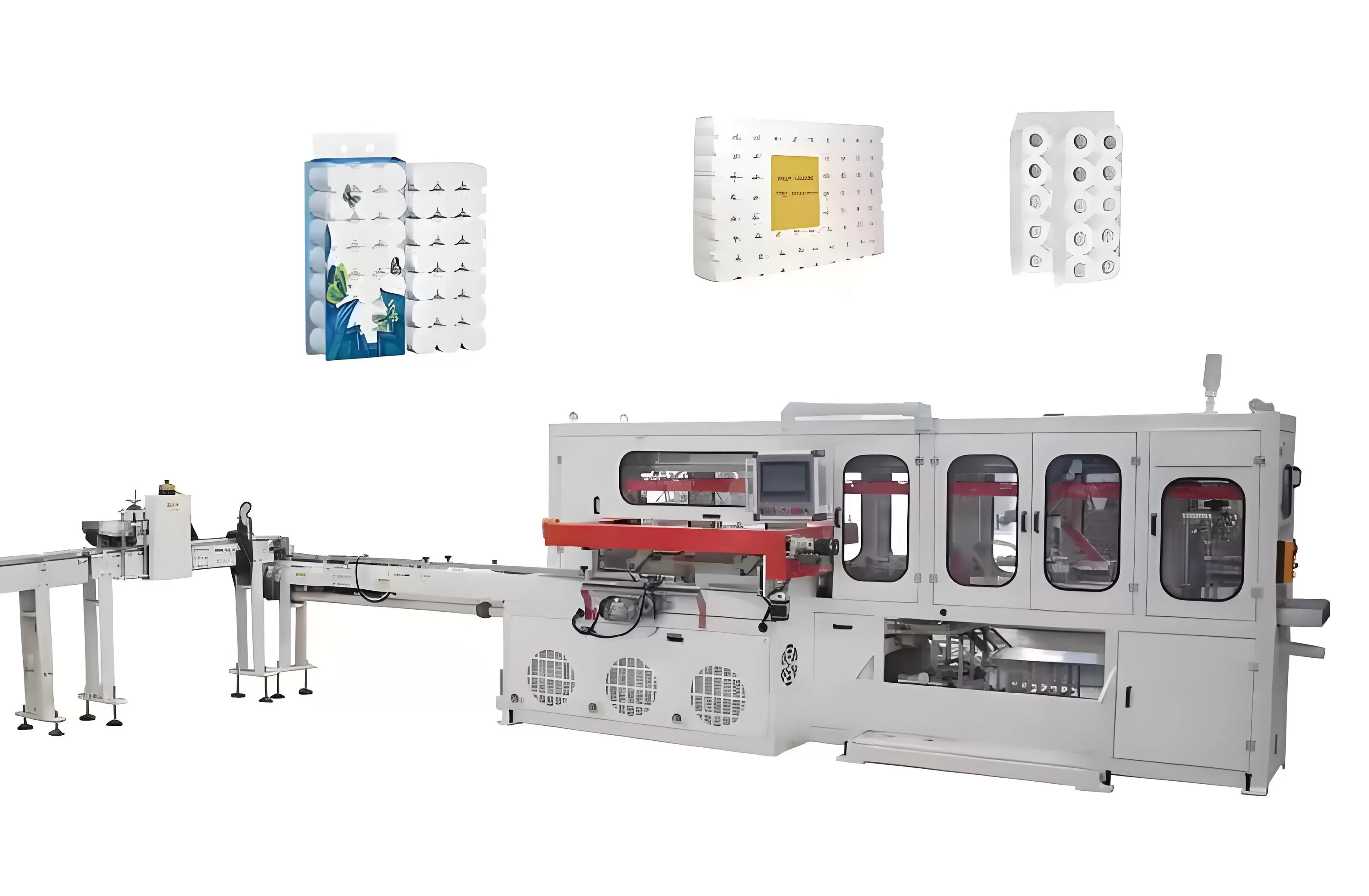
Automatic Toilet Paper Bundling Machine
The Automatic Toilet Paper Bundling Machine is designed for the secondary grouping and bagging of toilet paper rolls. It automatically completes product feeding, counting, arrangement, bag taking, bag opening, product insertion, gusset forming, heat sealing and finished-bundle discharge.
The machine can pack core or coreless toilet rolls directly, or group individually wrapped rolls into larger retail and wholesale packages. It is suitable for toilet paper factories seeking to reduce manual counting, bag opening and product loading.
Suitable Toilet Paper Products
Standard toilet paper rolls with cardboard cores
Coreless toilet paper rolls
Individually wrapped toilet rolls
Embossed household toilet paper rolls
Compact toilet roll bundles
Kitchen towel roll bundles within the confirmed size range
The machine is not a toilet paper rewinder or log saw. It receives finished rolls from the upstream cutting, conveying or individual wrapping section and combines them into a larger bag.
Available Bundle Formats
Common toilet paper bundle arrangements include:
2 × 3 arrangement, 6 rolls per bundle
2 × 4 arrangement, 8 rolls per bundle
2 × 5 arrangement, 10 rolls per bundle
2 × 6 arrangement, 12 rolls per bundle
Customized single-layer or multi-layer arrangements
The available format depends on the roll diameter, roll width, bundle height and bag dimensions. The required arrangements should be confirmed before the grouping mechanism and control program are finalized.
Automatic Product Feeding
The upstream conveyor transfers finished toilet paper rolls into the bundling machine. A dual-lane or three-lane feeding system separates and aligns the products before counting.
Photoelectric sensors monitor the arrival and position of each roll. Servo-controlled belts coordinate product spacing and reduce collisions between rolls.
The feeding direction, conveyor height and product orientation must match the upstream log saw, individual wrapping machine or finished-roll conveyor.
Counting and Arrangement
The control system counts the required number of toilet rolls and arranges them into the selected row, column and layer format.
The arrangement can be changed through the touch screen within the confirmed operating range. Mechanical adjustment or change parts may be required when the roll diameter, width or bundle structure changes substantially.
Pre-Made Bag Feeding
Pre-made PE or CPP bags are loaded onto the bag-storage racks. Depending on the selected configuration, the machine can hold up to approximately 600 bags and use two storage positions for continuous replenishment.
The vacuum system collects one bag and opens the bag mouth. Sensors confirm whether the bag has opened correctly before the products are inserted.
An incorrectly opened bag can be rejected automatically to prevent the grouped products from entering an unstable package.
Product Insertion and Sealing
After the required number of rolls is arranged, a servo-controlled pusher inserts the complete product group into the opened bag.
The machine forms the side gussets and transfers the filled bag into the heat-sealing section. Independent temperature control helps maintain a stable seal with different packaging materials.
The excess bag edge is trimmed and collected. The completed toilet paper bundle is then transferred to the discharge conveyor.
Production Speed
The practical working speed is approximately 15 to 22 bundles per minute. The maximum design speed can reach approximately 25 bundles per minute under suitable product and bag conditions.
Actual output depends on:
Toilet roll diameter and width
Number of rolls per bundle
Single-layer or multi-layer arrangement
Pre-made bag quality
Bag opening stability
Upstream product feeding
Heat-sealing time
Product changeover frequency
A six-roll bundle and a twelve-roll bundle should not be expected to maintain exactly the same practical output.
Servo and PLC Control
The machine uses PLC and multi-axis servo control to coordinate product feeding, counting, grouping, bag taking, product insertion and sealing.
The touch screen can display or adjust:
Bundle arrangement
Number of rolls
Conveyor speed
Product pushing position
Bag length settings
Sealing temperature
Production quantity
Alarm and fault information
Stored product settings can reduce adjustment time when the factory returns to a previously confirmed bundle format.
Safety and Fault Detection
The machine can include overload protection, emergency-stop devices, safety guards, interlocking access doors and fault alarms.
Detection functions can monitor:
Missing toilet rolls
Incorrect product position
Bag pickup failure
Bag opening failure
Low compressed-air pressure
Servo overload
Sealing temperature abnormalities
Blocked product discharge
Fault information is displayed on the touch screen to help the operator identify the affected section.
Connection with Upstream Equipment
The bundling machine can receive products from an automatic toilet paper log saw, finished-roll conveyor or individual roll wrapping machine.
Before connecting the equipment, confirm:
Finished roll dimensions
Product orientation
Upstream practical output
Conveyor width and height
Feeding direction
Required product accumulation
Start and stop signals
Emergency-stop interlocking
The upstream machine capacity should be matched to the bundler’s practical output. Excess products may require an accumulation conveyor to prevent frequent line stops.
Packaging Material Requirements
The standard machine uses heat-sealable pre-made PE or CPP bags. The bag should open reliably under vacuum and should not have excessive static electricity or adhesion between its inner surfaces.
The confirmed bag specification should include:
Bag length
Bag width
Side gusset dimensions
Film thickness
Heat-sealing temperature range
Vent-hole requirements
Handle-hole position, if required
Printed pattern position, if applicable
Bag samples should be tested before continuous production when the customer uses printed, handled or specially shaped packaging.
Utilities and Installation
The reference installed power is approximately 19 to 25 kW. The machine requires compressed air at approximately 0.6 MPa, with normal air consumption of about 300 to 500 L/min.
The workshop should reserve space for the machine, infeed conveyor, bag replenishment, finished-bundle discharge, electrical cabinet access and maintenance.
A clear operating area of approximately 9 × 6 m is recommended, although the final requirement depends on the conveyor direction and selected equipment configuration.
Information Required for Configuration
Before confirming the machine, provide the toilet roll diameter, roll width, core or coreless structure, individual wrapping status, number of rolls per bundle, product arrangement, finished bundle dimensions, bag material, bag thickness, required output and upstream equipment information.
The final feeding system, grouping mechanism, bag-opening device, installed power and overall dimensions will be confirmed according to the selected product and packaging format.
Configuration Note
The Automatic Toilet Paper Bundling Machine is used for secondary grouping and bagging. It does not replace
Line Connection
The bundling machine receives counted finished rolls after a toilet paper rewinding machine and cutting section. Conveyor height, roll direction, bundle pattern and control signals should be confirmed before the machines are connected.
How the machine processes the material
The Automatic Toilet Paper Bundling Machine receives toilet paper rolls or individually wrapped roll packs from the upstream conveyor. The feeding system separates, counts and arranges the products according to the selected bundle format.
The operator sets the roll dimensions, number of products, bundle arrangement and bag length through the touch screen. Servo-controlled conveyors and pushing mechanisms coordinate product feeding, grouping and transfer.
Empty pre-made bags are stored on the bag racks. The vacuum bag-opening system collects one bag, opens the bag mouth and positions it in front of the grouped toilet paper products.
When the required number of rolls has been arranged, the servo pusher transfers the complete group into the opened bag. The machine then forms the side gussets, removes excess air and transfers the package to the sealing section.
The heat-sealing unit closes the bag and trims the excess material. The completed bundle is discharged automatically to the finished-product conveyor.
If a bag fails to open correctly or a product is not positioned properly, the detection system stops or rejects the abnormal package. Fault information is displayed on the touch screen for inspection.
The machine can connect with an automatic log saw, finished-roll conveyor or individual wrapping machine. The upstream product orientation, conveyor height and practical output must be matched before the equipment is connected.
Machine data for configuration review
| Machine Name | Automatic Toilet Paper Bundling Machine |
|---|---|
| Machine Model | TP-B600 Automatic Series |
| Suitable Products | Core toilet rolls, coreless toilet rolls, individually wrapped toilet rolls and kitchen towel rolls |
| Design Speed | Up to 25 bundles/min |
| Practical Working Speed | 15 to 22 bundles/min |
| Bundle Length | 170 to 690 mm |
| Bundle Width | 160 to 360 mm |
| Bundle Height | 80 to 280 mm |
| Toilet Roll Diameter | Approximately 80 to 130 mm |
| Toilet Roll Width | Approximately 80 to 170 mm |
| Common Bundle Formats | 2 × 3, 2 × 4, 2 × 5, 2 × 6 and customized arrangements |
| Packaging Material | PE or CPP pre-made bags |
| Bag Storage Capacity | Up to approximately 600 pre-made bags |
| Bag Opening | Vacuum bag-opening system |
| Sealing Method | Temperature-controlled heat sealing |
| Control System | PLC control with touch-screen operation |
| Drive System | Multi-axis servo control |
| Installed Power | Approximately 19 to 25 kW |
| Compressed-Air Pressure | 0.6 MPa |
| Compressed-Air Consumption | Approximately 300 to 500 L/min |
| Reference Machine Weight | Approximately 3000 to 3800 kg |
| Reference Dimensions | Approximately 5600 × 3500 × 2200 mm |
| Power Supply | 380 V, 50 Hz, three-phase, or customized |
The listed specifications describe a configurable machine. The practical speed, bundle range and machine dimensions depend on the toilet roll size, number of rolls, arrangement pattern, bag dimensions and upstream feeding method.
Functions available by requirement
Machines used before or after this process
Design speed and reference output are not the same value. Practical production depends on raw material, finished-product dimensions, machine configuration, operator preparation and the capacity of connected equipment.