
Process, equipment connection and operating requirements
Review how the complete line is arranged, which finished products it supports, how packaging is handled and what factory conditions should be confirmed.
Production process and equipment connection
The Fully Automatic Disposable Cleaning Cloth Production Line converts spunlace nonwoven fabric or other approved wiping materials into perforated rolls or folded cleaning cloths. The connected line can complete material unwinding, web guiding, embossing, perforating, slitting, rewinding or folding, cutting, counting and packaging.
The line is suitable for dry household cleaning wipes, kitchen cleaning cloths, reusable-style disposable cloths, perforated wipe rolls and folded multi-piece packs. It is not a wet wipes production line and does not include liquid preparation, wetting, lid application or wet-wipe sealing unless those systems are specified separately.
Suitable Finished Products
Perforated disposable cleaning cloth rolls
Coreless roll wipes
Kitchen cleaning cloths
Household dusting wipes
Disposable table-cleaning cloths
Folded nonwoven cleaning sheets
Stacked multi-piece cleaning cloth packs
Industrial dry wiping cloths
The final configuration depends on whether the product is supplied as a perforated roll, an individually cut sheet or a folded stack. These formats require different rewinding, folding, cutting and packing equipment.
Reference Technical Parameters
Effective working width: 1600 to 2200 mm
Maximum jumbo roll diameter: 1200 to 1500 mm
Raw material basis weight: approximately 30 to 100 g/m²
Practical operating speed: 150 to 220 m/min
Finished sheet width: approximately 180 to 600 mm
Finished sheet length: approximately 200 to 800 mm
Perforation length: adjustable according to product size
Roll-type output: approximately 20 to 50 rolls/min
Folded-sheet output: approximately 400 to 1000 sheets/min
Installed power: approximately 45 to 75 kW
Operators: 3 to 5 people per shift
Compressed-air pressure: 0.6 to 0.8 MPa
Published comparable lines use nonwoven fabric up to approximately 2200 mm wide and operate at around 200 to 250 m/min. Actual output must still be calculated from the material weight, finished dimensions, roll or folded format and packaging speed. 【1-a5ae08】【2-e758ee】
Production Process
Nonwoven Fabric Unwinding
The jumbo roll is installed on the unwind stand and fed continuously into the production line. The unwinding section can include pneumatic roll loading, shaftless clamping, web tension control and automatic edge guiding.
Stable feeding is important because variations in tension can affect embossing alignment, perforation position, sheet dimensions and winding quality.
Embossing
The material can pass through an embossing unit to form the required surface texture. Embossing can improve the appearance, wiping structure and perceived thickness of the finished cleaning cloth.
The embossing pressure and pattern should be selected according to the nonwoven material, basis weight, thickness and tensile strength. Excessive pressure may weaken the material or produce uneven edges.
Perforating and Slitting
For roll-type cleaning cloths, the material is perforated at the required sheet length and slit into the selected product width.
The perforation should allow each cloth to be separated easily while maintaining sufficient strength during rewinding, packaging and transport. Slitting knives are positioned according to the required roll width and the number of lanes.
Rewinding
The slit and perforated material is rewound into finished cleaning cloth rolls. The machine controls the winding length, roll diameter, web tension and winding firmness.
Coreless rewinding can be used when the finished roll does not require a cardboard core. A core-feeding system can be added when the product must be wound onto paper tubes.
Folding and Cutting
For folded or stacked cleaning cloths, the material enters a folding and cutting section instead of the roll rewinder.
The line can be configured for half-fold, multi-fold, Z-fold or another confirmed folding method. The cutting system divides the continuous material into finished sheets before automatic counting and stacking.
Counting and Stacking
Finished sheets are automatically counted and arranged into stacks according to the required number of cloths per pack.
Common pack quantities include 20, 30, 40, 50, 80 or 100 sheets. The counting and stacking system should be matched to the cutting speed and final pack height.
Automatic Packaging
Roll-type products can be individually wrapped or grouped into multi-roll bags. Folded cleaning cloths can be packed as stacked multi-piece packs.
The packing machine can complete product feeding, film forming, sealing, cutting and finished-pack discharge. Optional production-date coding, labeling, bundle packing and carton sealing equipment can be added.
Main Equipment
Nonwoven jumbo roll unwind stand
Automatic web-guiding system
Web tension-control system
Embossing unit
Perforating system
Multi-lane slitting unit
Coreless or core-type rewinding machine
Automatic folding and cutting machine
Sheet counting and stacking system
Finished-product conveyors
Roll wrapping or sheet-pack packaging machine
Finished-pack discharge conveyor
PLC control cabinets
Safety guards and interlocking devices
The production line does not need to include both the roll rewinding section and the folded-sheet section in every project. The equipment should be selected according to the required finished product.
Automation and Operators
The connected line can automatically complete material feeding, tension control, embossing, perforating, slitting, rewinding or folding, cutting, counting, stacking and primary packaging.
The standard production line requires approximately 3 to 5 operators per shift. Operators remain responsible for jumbo roll replacement, packaging-film replenishment, product inspection, specification changeover, waste removal, cleaning and routine maintenance.
A stable roll-wipe line may operate with three people. A folded-sheet line with several packing channels, frequent size changes or manual carton handling may require four or five people.
Installed Power and Utilities
A standard roll-type production line requires approximately 45 to 75 kW of installed power. A configuration with folding, automatic stacking and several packaging machines may require approximately 60 to 90 kW.
The recommended factory electrical capacity is approximately 100 to 150 kVA. The actual requirement depends on the number of lanes, embossing system, rewinding or folding configuration, packaging equipment and air compressor.
Compressed-air pressure should normally be maintained at 0.6 to 0.8 MPa, with approximate consumption of 1.5 to 3.0 m³/min.
Workshop Requirements
The recommended line footprint is approximately 25 to 38 m long and 8 to 12 m wide. A total workshop area of approximately 450 to 750 m² is recommended.
The workshop should reserve sufficient space for jumbo roll storage, material loading, packaging-film storage, finished products, operator passages, electrical cabinets and equipment maintenance.
The final layout must be confirmed according to the product direction, number of lanes, packaging equipment, workshop doors, columns and utility connection points.
Information Required for Configuration
Before confirming the production line, provide the raw material type, material basis weight, jumbo roll width and diameter, finished cloth width and length, perforation size, roll or folded format, sheets per pack, required output, packaging method, workshop dimensions and destination voltage.
The final working width, number of lanes, cutting method, rewinding or folding configuration, packaging equipment, installed power and line dimensions will be selected according to these production requirements.
Configuration Note
The reference speed and output on this page apply to a configurable dry disposable cleaning cloth production line. Actual capacity depends on the nonwoven material, basis weight, finished dimensions, number of lanes, perforation or folding method and packaging configuration.
The final technical proposal should clearly state whether the line produces perforated rolls or folded sheets. The guaranteed output, installed power, operator requirement and workshop dimensions must be based on the confirmed finished product.
Primary and secondary packing options
Equipment arrangement and workshop flow
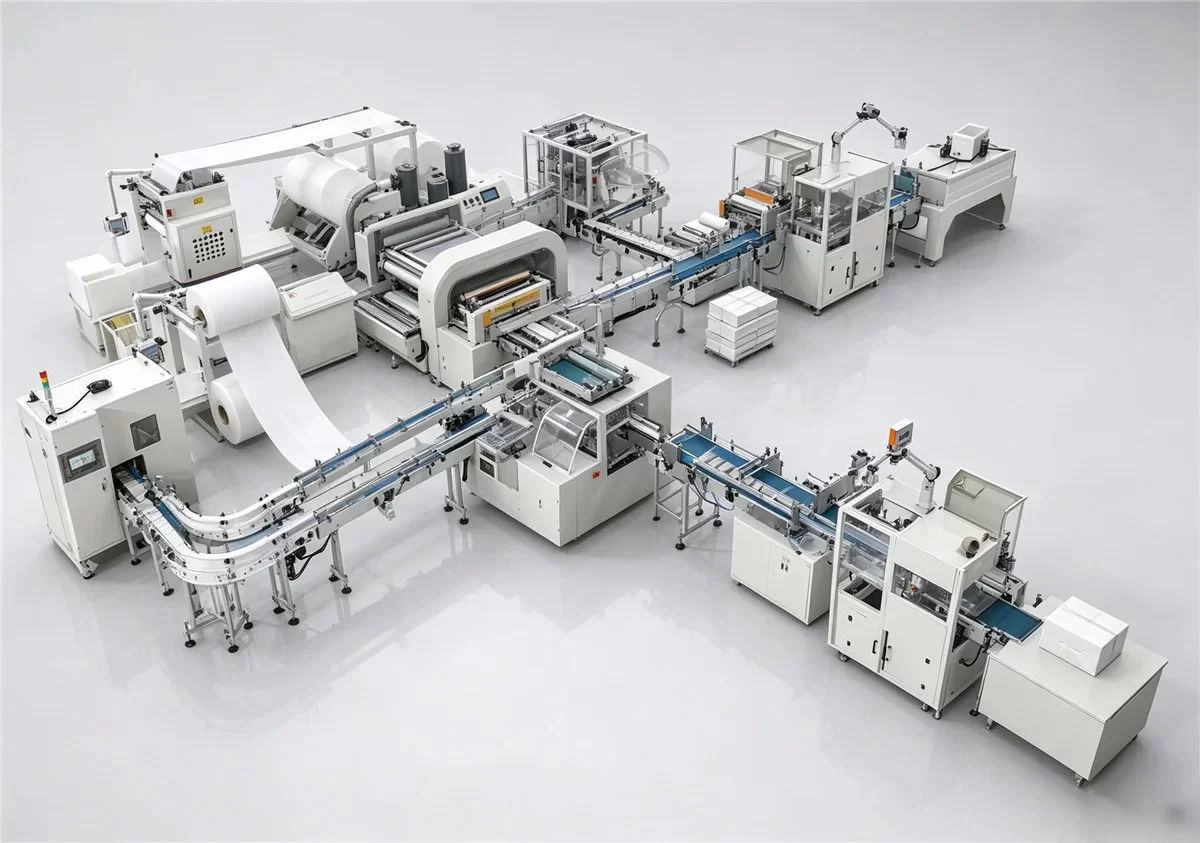
Practical output, operator quantity, installed power and workshop space depend on the final equipment combination, finished-product dimensions, packing format and operating conditions. Confirm these values in the final technical proposal.