
Function, configuration and line compatibility
Review how the machine works, what it can produce and which optional functions or supporting equipment may be needed for the complete process.
Machine overview and suitable production use
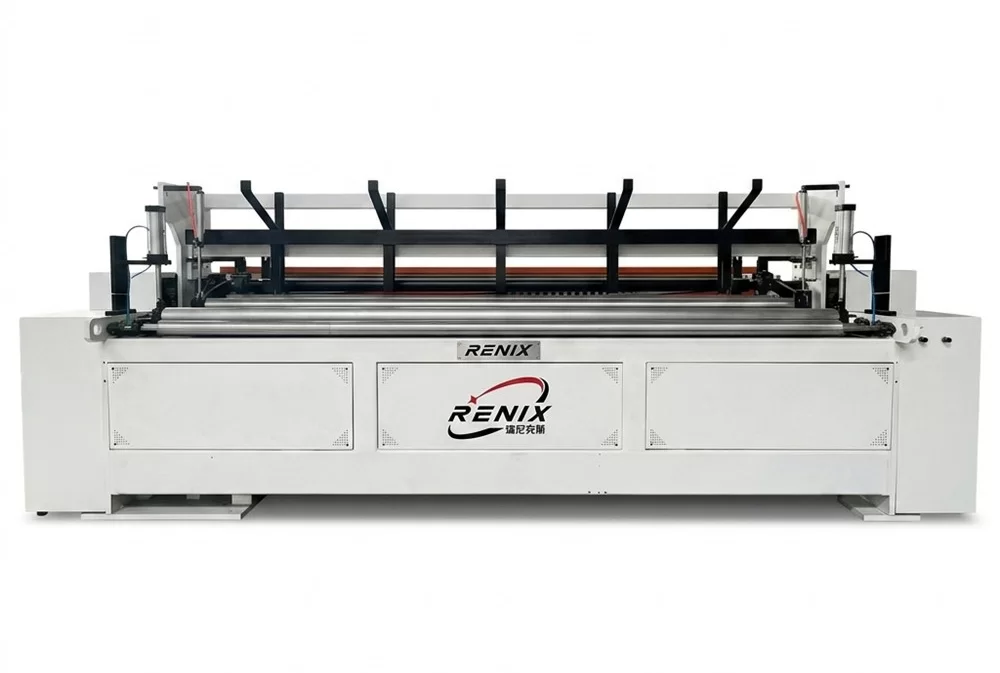
3000 Automatic Toilet Paper Rewinding Machine
The 3000 Automatic Toilet Paper Rewinding Machine is a wide-format converting machine designed for medium-sized and large toilet paper factories. It processes jumbo tissue rolls into embossed, perforated and rewound toilet paper logs with a maximum raw paper width of approximately 3000 to 3050 mm.
Compared with narrower 1880 mm and 2200 mm models, the 3000 series processes a wider paper web during each production cycle. It is suitable for factories requiring higher shift output or planning to connect the rewinder with an automatic log saw and high-capacity packing equipment.
Suitable Toilet Paper Products
Standard household toilet paper rolls
Toilet paper rolls with cardboard cores
Coreless toilet paper rolls
Two-ply, three-ply and four-ply toilet paper
Full-embossed toilet paper rolls
Edge-embossed toilet paper rolls
Glue-laminated toilet paper
Perforated toilet paper logs for automatic cutting
The machine produces long toilet paper logs. A cutting machine is required to divide the logs into finished retail rolls, while the packaging method is determined by the required individual or multi-roll pack.
Wide Working Width
The machine has an effective working width of 3000 mm and can process jumbo tissue rolls up to approximately 3050 mm wide. The wider web allows more finished rolls to be produced across each toilet paper log after cutting.
Two, three or four unwind stands can be selected according to the number of paper plies. Each stand can use independent tension adjustment to maintain stable paper feeding across the full working width.
Embossing and Ply Bonding
The rewinder can be equipped with one or two embossing units. Available options include steel-to-rubber embossing, steel-to-steel embossing, full-width embossing, edge embossing and customized patterns.
A glue lamination system can be added for premium multi-ply toilet paper. The paper strength, embossing depth and glue quantity must be coordinated to prevent paper breakage, excessive hardness or unstable rewinding.
Core and Coreless Production
An automatic core feeding system can load cardboard cores into the rewinding section. The standard finished core diameter is approximately 20 to 50 mm, while other sizes can be configured according to the finished toilet roll.
A coreless rewinding device can be added when the factory produces toilet rolls without cardboard cores. Core and coreless production use different winding and product-release methods, so the required functions must be confirmed before manufacturing.
Practical Production Capacity
The practical rewinding speed is approximately 150 to 250 m/min. Under normal production conditions, the machine can process approximately 4 to 7 tons of paper during an 8-hour shift.
Actual output depends on the raw paper basis weight, number of plies, finished roll weight, embossing pattern, perforation length, product changeover and normal operating efficiency.
The capacity of the downstream cutting and packaging equipment must also match the rewinder. A high-speed rewinder cannot maintain its practical output if toilet paper logs wait for manual cutting or if the packing machine has insufficient capacity.
Machine Structure and Control
The machine uses a heavy steel-plate structure to support the wider paper web and reduce vibration during rewinding and perforating. The main transmission, perforating rollers and winding components are arranged to maintain stable operation across the 3000 mm working width.
The PLC and touch-screen system allow the operator to set the rewinding speed, finished roll diameter, sheet count, perforation length, core feeding sequence and log discharge timing.
Paper-break detection, fault alarms, emergency-stop devices and safety guards can be included to improve operational safety and simplify fault inspection.
Connection with Cutting Equipment
For a semi-automatic production arrangement, the completed toilet paper logs can be cut by a band-saw cutting machine. This configuration has a lower initial investment but requires manual log feeding and positioning.
For higher output, the rewinder can connect with a log accumulator and an automatic log saw. The accumulator creates a buffer between rewinding and cutting, while the automatic log saw controls the finished roll width and cutting sequence.
Connection with Packaging Equipment
After cutting, the finished toilet rolls can be transferred to an individual wrapping machine or a multi-roll packing machine.
Common retail pack formats include 4, 6, 8, 10 and 12 rolls. The packing machine must be selected according to the finished roll diameter, roll width, number of rolls per pack, film specification and required output.
Factory Requirements
The reference machine dimensions are approximately 7500 × 5200 × 2300 mm. A working area of at least 12 × 9 m is recommended for the rewinder, jumbo roll replacement, operator access, electrical cabinets and maintenance.
The factory should provide a level reinforced floor, a three-phase industrial power supply, compressed air at 0.6 to 0.8 MPa and suitable jumbo roll lifting equipment.
Information Required Before Configuration
Before confirming the machine, provide the jumbo roll width and diameter, paper basis weight, number of plies, finished roll width and diameter, roll weight, sheets per roll, perforation length, core diameter, embossing requirement, required shift output and destination voltage.
Information about the planned cutting and packing equipment is also required when the rewinder will be connected to a complete production process. This allows the machine discharge direction, conveyor height and production capacity to be coordinated in advance.
Configuration Note
The 3000 Automatic Toilet Paper Rewinding Machine is a single converting machine, not a complete toilet paper production line. Automatic cutting, individual wrapping, multi-roll packing and secondary handling require separate supporting equipment.
The final machine speed, installed power, dimensions and production capacity will be confirmed according to the selected paper, finished toilet roll and optional configuration.
How the machine processes the material
The 3000 Automatic Toilet Paper Rewinding Machine converts jumbo tissue rolls into perforated and embossed toilet paper logs. It combines paper unwinding, tension control, embossing, perforating, automatic core feeding, rewinding, tail sealing and log discharge in one machine.
Jumbo tissue rolls are installed on two, three or four unwind stands according to the required number of paper plies. Each paper web is unwound independently and passes through the tension-control system. An optional web-guiding device can correct lateral paper movement and maintain consistent edge alignment.
The paper then enters the embossing section. One or two embossing units can be installed for full embossing, edge embossing, point-to-point embossing or ply bonding. A glue lamination unit can be added when stronger bonding between the paper plies is required.
After embossing, the perforating unit creates evenly spaced tear lines according to the preset sheet length. The perforation length is adjustable to match different toilet paper specifications.
The perforated paper is rewound onto a cardboard core or a coreless winding device. The PLC control system coordinates paper feeding, perforating, core feeding and rewinding. The finished roll diameter, sheet count, perforation length and winding firmness can be adjusted through the touch screen.
When the preset diameter or sheet count is reached, the machine cuts the paper web, applies glue to the paper tail and discharges the completed toilet paper log. A new cardboard core is then fed automatically to begin the next rewinding cycle.
The machine produces long toilet paper logs rather than individually cut retail rolls. The logs must be cut by an automatic log saw or a band-saw cutting machine before entering the packaging process.
Machine data for configuration review
| Machine Name | 3000 Automatic Toilet Paper Rewinding Machine |
|---|---|
| Machine Model | 3000 Automatic Series |
| Effective Working Width | 3000 mm |
| Maximum Raw Paper Width | 3000 to 3050 mm |
| Maximum Jumbo Roll Diameter | 1500 to 1600 mm |
| Jumbo Roll Core Diameter | 76.2 mm |
| Raw Paper Basis Weight | 13 to 24 g/m² per ply |
| Number of Paper Plies | 1 to 4 plies |
| Finished Roll Diameter | 50 to 180 mm |
| Finished Roll Core Diameter | 20 to 50 mm |
| Perforation Length | 90 to 150 mm, adjustable |
| Practical Rewinding Speed | 150 to 250 m/min |
| Maximum Design Speed | Up to 300 m/min |
| Reference Capacity | Approximately 4 to 7 tons per 8-hour shift |
| Installed Power | Approximately 30 to 45 kW |
| Compressed-Air Pressure | 0.6 to 0.8 MPa |
| Compressed-Air Consumption | Approximately 1.0 to 2.0 m³/min |
| Control System | PLC control with touch-screen operation |
| Speed Regulation | Variable-frequency or servo control |
| Reference Dimensions | Approximately 7500 × 5200 × 2300 mm |
| Reference Machine Weight | Approximately 7 to 10 tons |
| Power Supply | 380 V, 50 Hz, three-phase, or customized |
The listed parameters describe a standard configurable machine. Actual speed, power, dimensions and output depend on the selected unwind stands, embossing system, raw
Functions available by requirement
Machines used before or after this process
Design speed and reference output are not the same value. Practical production depends on raw material, finished-product dimensions, machine configuration, operator preparation and the capacity of connected equipment.