
Process, equipment connection and operating requirements
Review how the complete line is arranged, which finished products it supports, how packaging is handled and what factory conditions should be confirmed.
Production process and equipment connection
Fully Automatic Bottom-Draw One-to-Two Facial Tissue Production Line
This line converts jumbo tissue rolls into V-fold facial tissues and then distributes the folded tissue logs to two downstream processing routes. The one-to-two arrangement supports both regular soft packs and larger bottom-draw packs, allowing one production system to serve different product formats and sales channels.
The seven-line folding section uses vacuum suction, spiral fixed-blade cutting, PLC control and automatic counting. After folding and separation, the tissue logs are directed to the appropriate rotary cutter. Servo positioning and continuous circular-knife cutting provide accurate pack length, while the selected packaging machine completes the corresponding finished pack.
Two Processing Routes
Route | Application |
Route A: Standard soft pack | Single-channel rotary cutter followed by a three-dimensional packaging machine. Suitable for individually wrapped regular facial tissue packs. |
Route B: Bottom-draw pack | Bottom-feed rotary cutter followed by a fully automatic bottom-feed packaging machine. Suitable for larger PE-wrapped bottom-draw tissue packs. |
Main Advantages
· One folding section supports two downstream product and packaging routes.
· Seven-line V-fold structure increases converting capacity for medium-scale production.
· PLC control, touch-screen operation and servo positioning simplify adjustment.
· Rotary cutting accuracy is below 1 mm under suitable operating conditions.
· Automatic knife sharpening reduces manual sharpening work and supports continuous cutting.
· Standard package dimensions and bottom-draw package dimensions can be selected for different markets.
· Optional embossing and edge pressing can improve tissue appearance and texture.
Main Technical Data
Parameter | Specification |
Maximum jumbo roll width | 1500 mm |
Paper basis weight | 12-16 g/m²; 2-ply, 3-ply or 4-ply |
Folding output | 20-25 tissue logs/min or 800-1000 sheets/min/lane, whichever limit is reached first |
Typical sheet size | 200 x 190 mm ±2 mm; cutting size adjustable |
Folding method | Continuous vacuum suction folding |
Rotary cutting speed | Up to 200 cuts/min for each listed cutter |
Rotary cutting range | L 90-230 x W 80-110 x H 25-100 mm; special height 10-130 mm |
Standard wrapping speed | 100-160 packs/min |
Standard package size | 100-220 x 90-100 x 50-100 mm |
Bottom-draw packaging speed | 25-30 packs/min |
Bottom-draw package size | L 140-500 x W 110-350 x H 76-100 mm |
Power supply | 380 V, 50 Hz; alternative standards available by agreement |
Compressed air | 0.5-0.8 MPa according to the selected machine |
Configuration Notes
The two packaging routes have different speed ranges and product size ranges. Actual line output is therefore determined by paper grade, ply, sheet count, tissue log dimensions, transfer method, selected production route and packaging material. The rated speed of one machine should not be treated as the guaranteed net output of the entire line.
Before final engineering, confirm jumbo roll dimensions, paper basis weight and ply, sheet size, sheets per pack, required standard and bottom-draw pack sizes, embossing, film structure, voltage, compressed-air supply and workshop dimensions. The final one-to-two distribution and conveyor arrangement should then be designed around the intended production schedule.
Primary and secondary packing options
Equipment arrangement and workshop flow
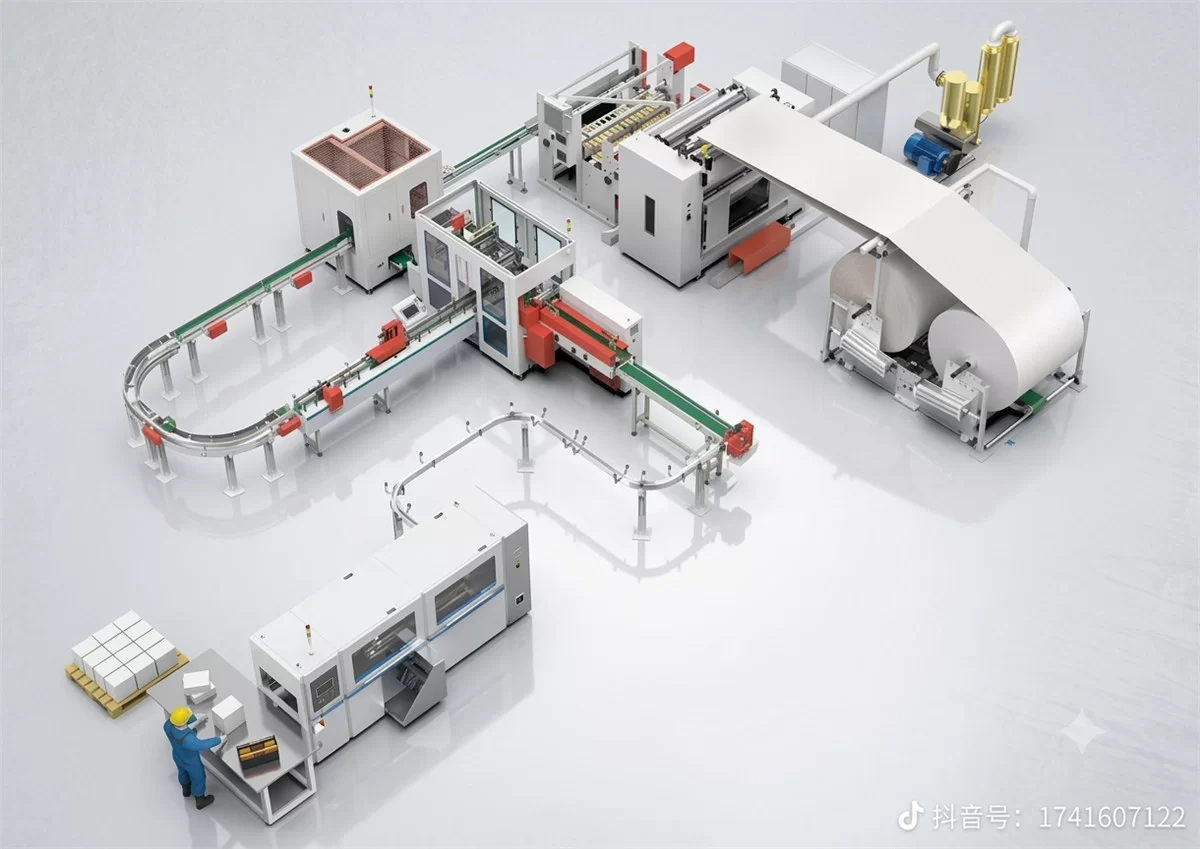
Practical output, operator quantity, installed power and workshop space depend on the final equipment combination, finished-product dimensions, packing format and operating conditions. Confirm these values in the final technical proposal.