
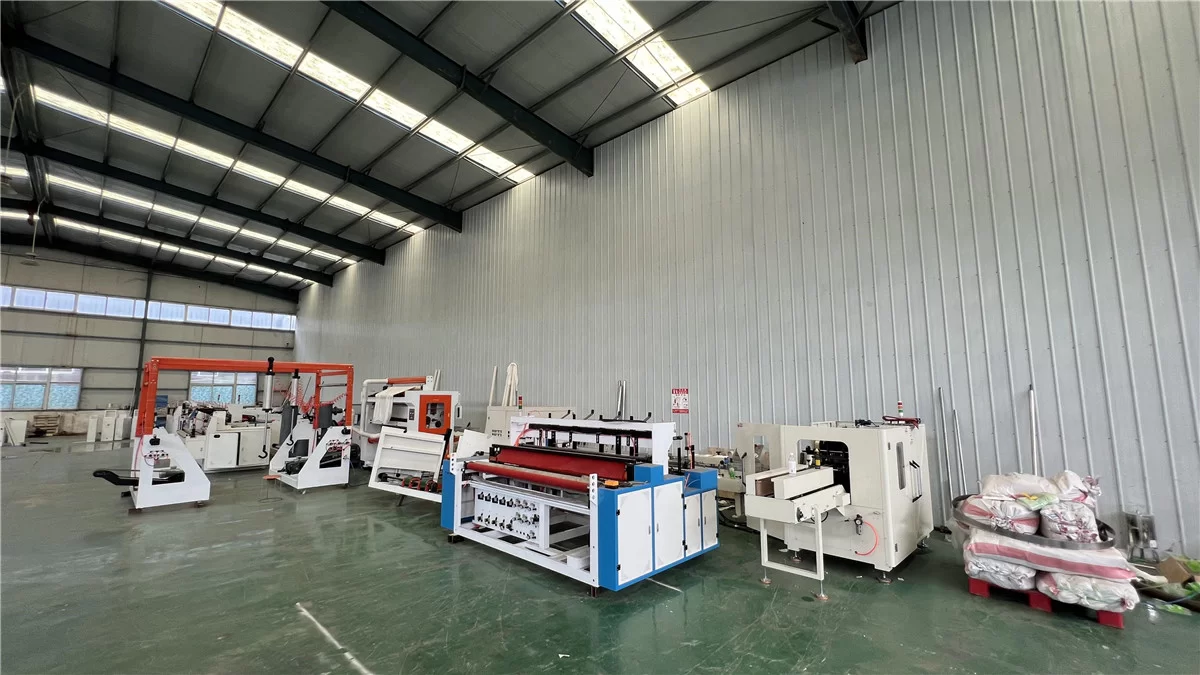
A tissue production-line layout should be reviewed before equipment is delivered to the customer’s factory.
Planning the layout early can reduce installation problems and create a clearer movement path for raw materials, operators, unfinished products and packed goods.
A useful layout is not simply a drawing that places every machine inside the available building. The complete production process and factory operating conditions must be considered.
Start with the Production Process
The layout should follow the actual production sequence.
A toilet paper production process may include:
Jumbo roll storage
Jumbo roll feeding
Rewinding
Embossing and perforation
Paper log discharge
Log cutting
Individual roll packing
Bundling
Carton handling
Finished-product storage
A facial tissue production process may include paper feeding, folding, tissue log formation, cutting, soft pack or bottom-draw packing and bundle packing.
The exact sequence depends on the planned finished product and selected equipment. Machines should therefore be arranged according to the process rather than placed only where empty floor space is available.
Reserve Space Around the Machines
Equipment dimensions represent only the physical machine body. Additional space is required for operation and maintenance.
Operators need access to control panels, adjustment points and product-transfer areas. Jumbo rolls and packing materials also require suitable handling space.
Maintenance access is particularly important around transmission sections, electrical cabinets, pneumatic components and parts that require periodic inspection.
If machines are positioned too close to walls or columns, routine maintenance may become difficult even though the equipment technically fits inside the building.
Plan Raw-Material Movement
Jumbo tissue rolls require storage and transport space.
The route from the storage area to the rewinding or folding machine should be reviewed before the production line is installed. Narrow doors, floor-level changes, columns or limited lifting access may affect material movement.
The selected handling method should be compatible with the jumbo roll dimensions and weight.
Raw-material movement should not unnecessarily cross the finished-product or packing area. A clearer direction of flow can reduce congestion and make factory organization easier.
Consider Product Transfer Between Machines
In a semi-automatic production line, operators may transfer paper logs, cut products or unpacked tissue between machines.
The layout should provide enough room for this work without blocking operating or maintenance areas.
In an automatic line, machine interfaces and conveyors determine the relative machine positions. Cutting and packing equipment must be aligned according to the transfer direction, height and product orientation.
A connected line requires more than placing two machines close together. The control sequence and physical transfer method must also be compatible.
Separate Packing and Finished-Product Areas
Packing materials require their own storage and supply area.
Film, bags, cartons and labels should be accessible to operators without obstructing the production path. Packed products also need a temporary collection area before they are moved to storage or loading.
If the packing area is too small, finished products can accumulate around the machines and restrict operator movement.
The layout should therefore show not only the manufacturing equipment but also the space needed after products leave the final machine.
Confirm Utilities Before Installation
Electrical power and compressed-air connections should be planned according to the confirmed machine positions.
The location of the control cabinet and utility entry points needs to be considered. Cables and pipelines should not cross walkways or create unnecessary obstacles around the equipment.
Customers should confirm voltage, frequency, phase and available power before installation. Compressed-air requirements should also be reviewed for equipment that uses pneumatic functions.
Ventilation, lighting and other local factory conditions may need to be considered according to the equipment and working environment.
Reserve Space for Future Upgrades
A new factory may begin with a semi-automatic configuration and add automatic cutting or packing equipment later.
If the initial layout occupies all available working space, future upgrades may require substantial machine relocation.
The layout can reserve an expansion direction even when the additional machine is not purchased during the first project stage.
Customers with existing equipment should also provide the dimensions, product-transfer direction and interface details of those machines before planning a new connection.
Information Required for a Layout Review
To discuss a preliminary tissue factory layout, the customer should provide:
Workshop length and width
Clear internal height
Door dimensions and positions
Column positions
Existing equipment
Required new equipment
Raw-material entry direction
Finished-product exit direction
Electrical supply locations
Compressed-air locations
Packing and storage requirements
Planned future upgrades
A clear factory drawing is more useful than a single total-area figure. The positions of fixed structures can significantly affect the final equipment arrangement.
A production-line layout should support safe operation, practical material flow, maintenance access and future development. Reviewing these points before delivery can make installation and subsequent factory operation more manageable.
Published by
Zhengzhou Renix Machinery Co., Ltd.
This update is prepared from company production, inspection, testing or delivery records. Equipment details should be read together with the confirmed project configuration.
Copyright © Zhengzhou Renix Machinery Co., Ltd.. Original text and photographs may not be reproduced for commercial use without written permission. Quotations must identify the source and link to the original page.