
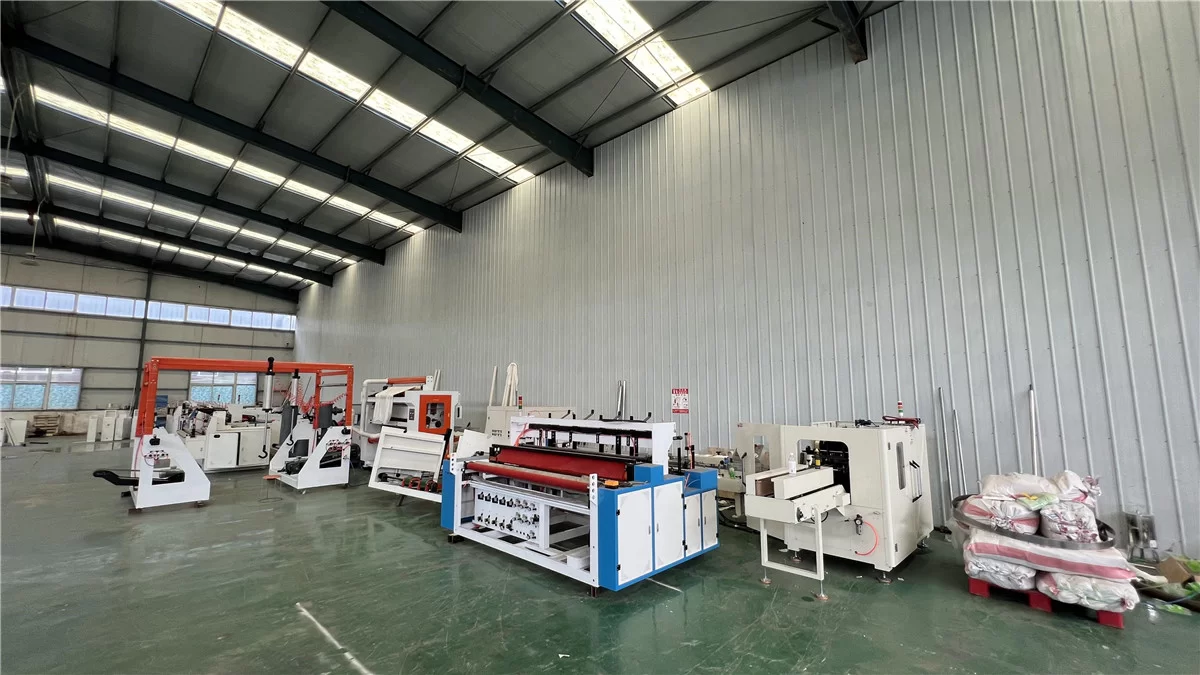
Equipment, factory checks and delivery evidence
The sections and photographs below document the actual work completed for this project.
An automatic toilet paper log saw completed a factory cutting test before delivery preparation.
The project inspection covered paper log feeding, positioning, clamping, blade movement, cutting-length adjustment and finished-roll discharge. The cut rolls were also checked against the dimensions used for the test.
Equipment Position in the Production Process
The automatic log saw is used after the toilet paper rewinding machine.
The rewinder converts jumbo tissue paper into long paper logs. The log saw then cuts these logs into individual toilet rolls according to the required roll width.
The upstream paper logs need to match the log saw’s accepted diameter, length and density range. If a paper log is excessively soft, deformed or inconsistent, the cutting process may require additional adjustment.
For this reason, the rewinder and log saw should be evaluated as connected production stages rather than unrelated machines.
Inspection Before Material Cutting
Before paper logs entered the cutting area, the machine was operated without material.
The inspection covered:
Infeed conveyor
Paper log positioning
Clamping movement
Blade sequence
Discharge movement
Sensor responses
Safety guards
Emergency-stop functions
This unloaded check helps confirm the operating sequence before material is placed near the cutting area.
The blade area and guarding should always be inspected according to the machine’s operating and maintenance requirements. Safety devices should not be bypassed during production.
Paper Log Feeding
The prepared paper logs were placed on the infeed section for the cutting test.
The project team observed whether the logs moved consistently toward the cutting position. The log diameter, density and external condition can all influence feeding stability.
The positioning system and related sensors were checked during repeated cycles. The paper log needs to reach the intended cutting position before the clamping and blade movements begin.
Clamping and Blade Movement
The clamping mechanism holds the paper log during cutting.
The test checked the sequence between positioning, clamping, blade movement and product discharge. These movements need to remain coordinated for repeated automatic operation.
Blade condition and adjustment affect the finished cut. However, the cut surface is also influenced by the paper material, log density, roll diameter and production settings.
A poor cutting result should therefore be investigated as a complete material-and-machine relationship rather than attributed to one component without inspection.
Cutting Length and Finished Rolls
The cutting length was set according to the product dimensions prepared for the trial.
Several finished rolls were reviewed for dimensional consistency and general cut appearance. One sample alone is not sufficient to evaluate repeated cutting operation.
The test also observed whether the finished rolls discharged in an orderly manner. Downstream handling is important if the log saw will connect directly with an individual roll packing machine or conveyor.
Packaging Preparation
After the planned cutting checks were completed, the machine entered delivery preparation.
The blade area, conveyor, guards, sensors and exposed electrical connections were inspected before protective packing. Movable sections were secured where required.
Accessories, tools and agreed spare parts were organized separately according to the packing list. This helps the customer identify components during unloading and installation.
If the project includes container loading photographs, the loading section should document the actual machine movement, loading order and securing process. If no loading record is available, the page should stop at delivery preparation rather than claim that shipment has already been completed.
Project Result
The automatic toilet paper log saw completed the planned feeding, positioning, cutting and discharge checks using the paper logs prepared for the factory test.
The equipment then proceeded to protective packing and the next confirmed delivery stage.
Before selecting a log saw, buyers should confirm the paper log diameter, paper log length, finished-roll width, target cutting arrangement, upstream rewinder and downstream packing method.