
Requirements, materials and converting route
Use the application requirements to identify suitable raw materials, production steps, equipment and packaging before a machine configuration is finalized.
Application Requirements
Suitable Raw Materials
Converting Process
Suitable Equipment
Packaging and Supply Formats
Key Quality Requirements
Product use and production considerations
Hotel Toilet Paper for Guest Rooms and Public Washrooms
Hotels use toilet paper in guest rooms, public washrooms, restaurants, conference areas and staff facilities. Although these areas may use similar tissue paper, the required roll diameter, paper quality, packaging and supply method can be different.
A guest-room toilet roll may need individual wrapping and a consistent appearance. A public washroom may use a larger roll to reduce replacement frequency. Housekeeping departments may prefer standardized cartons that simplify storage and room distribution.
Hotel toilet paper should therefore be defined according to the actual dispenser, consumption level and replenishment method rather than treated as one universal product.
Finished Roll Requirements
Equipment selection should begin with the finished toilet roll. The hotel, distributor or tissue converter should confirm the product specifications before selecting the rewinding, cutting and packing equipment.
Finished-roll width
Finished-roll diameter
Core diameter
Number of plies
Paper basis weight
Perforation length
Embossing requirement
Number of sheets per roll
Individual wrapping requirement
Number of rolls per bag or carton
The finished-roll diameter and core diameter must match the installed dispenser. A roll that is too large may not fit or rotate freely. A smaller roll may require more frequent replacement and increase the workload for housekeeping staff.
Winding density also needs to remain consistent. A loosely wound roll can deform during transport, while an excessively tight roll may reduce the expected bulk and softness.
Guest-Room Toilet Rolls
Guest-room toilet paper is often selected according to the hotel category, room design and housekeeping procedures. The product may be placed directly on a holder, stored as a spare roll or supplied through a covered dispenser.
Individual wrapping is useful when spare rolls are placed in the room. The wrapper protects the roll from dust and direct handling and can also carry private-label information.
Hotel or distributor branding
Product description
Number of plies
Batch information
Storage instructions
Private-label artwork
Individually wrapped rolls can be loaded into larger bags or cartons for transport. The outer package should protect the rolls without compressing them.
Public Washroom Supply
Public washrooms normally have a higher rate of consumption than guest rooms. Larger rolls or jumbo rolls may be selected to reduce replacement frequency.
The buyer should consider the dispenser capacity, daily visitor volume, expected sheet consumption and available storage space. A larger roll can reduce replenishment work, but the selected rewinding and cutting equipment must be able to process the required roll diameter.
Dispenser capacity
Roll and core diameter
Replacement frequency
Number of sheets
Daily consumption
Storage and replenishment method
Raw Material Selection
Hotel toilet paper can be made from virgin tissue paper, recycled tissue paper or a blended grade. The material choice should reflect the intended market position and use area.
Virgin tissue is commonly selected when softness, cleanliness and surface appearance receive greater attention. Recycled or blended grades can be considered for public washrooms, staff facilities and cost-controlled supply contracts.
The jumbo roll should be reviewed for width, diameter, basis weight, number of plies, tensile strength, softness, moisture and roll condition. Material variation can influence paper feeding, embossing, perforation, rewinding and cutting.
Rewinding and Embossing
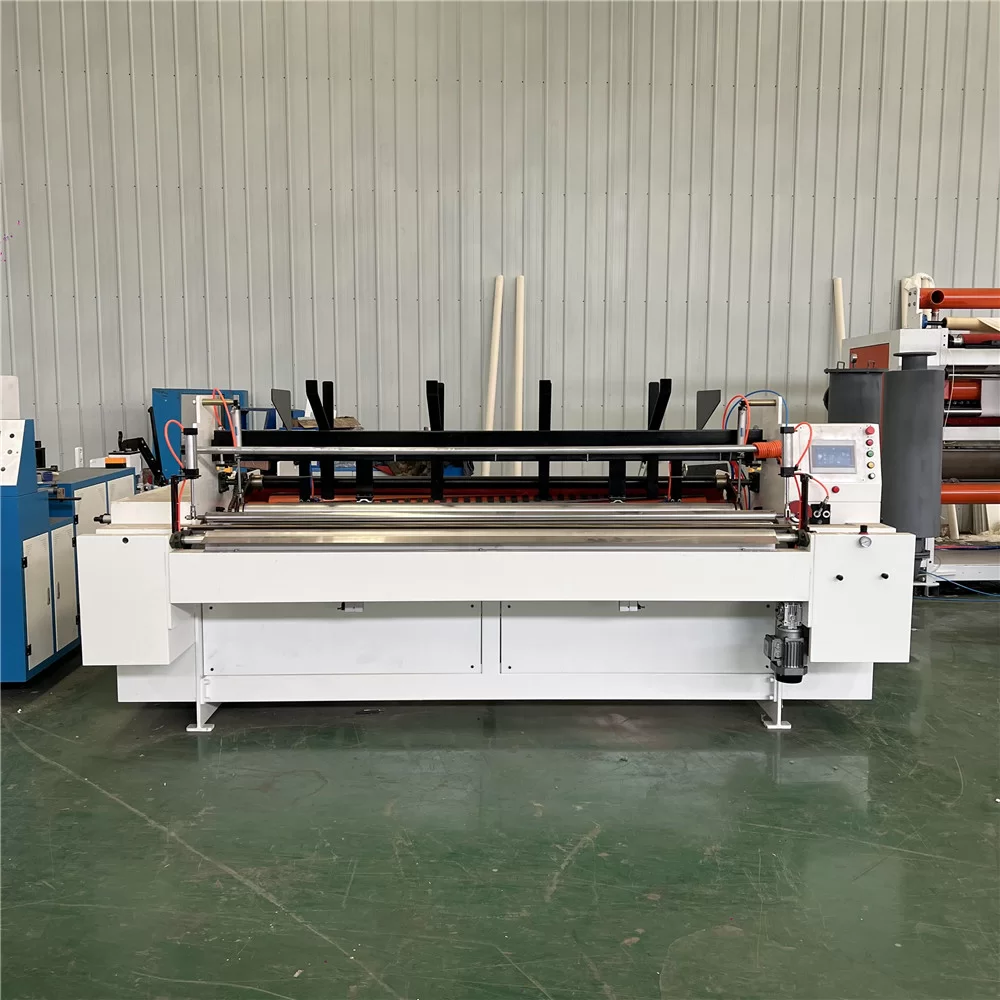
The toilet paper rewinding machine converts jumbo tissue rolls into long paper logs. Depending on the selected configuration, the machine can complete unwinding, web alignment, embossing, perforation, core feeding, rewinding and log discharge.
Embossing can improve the surface appearance and apparent bulk of the finished roll. The pattern and pressure should match the paper grade and target product. Excessive pressure can make the paper feel firmer or damage lightweight tissue.
If the hotel or distributor requires a custom pattern, the effective embossing width and pattern drawing should be confirmed before the embossing rollers are manufactured.
Log Cutting
After rewinding, the paper logs must be cut into individual toilet rolls. An automatic log saw is suitable for repeated production and more consistent finished-roll widths. A band saw can be considered when the initial output is lower and the production process remains operator-assisted.
The cutting result is affected by several factors:
Blade condition
Paper softness
Paper log density
Finished-roll diameter
Clamping adjustment
Cutting speed and roll width
The cut surfaces should be clean and reasonably flat. Torn edges, excessive compression and inconsistent roll widths should be corrected before packing.
Packaging for Hotel Distribution
The packaging format should follow the hotel’s storage and replenishment process. Individually wrapped rolls are suitable for room distribution, while larger multi-roll bags may be better for housekeeping storage.
Individually wrapped rolls
Four-roll or six-roll bags
Large housekeeping packs
Bulk cartons with protected inner rolls
Private-label hotel packaging
Outer cartons should protect the rolls from crushing, moisture and contamination. The carton size should also allow efficient warehouse stacking and delivery.
Suitable Production Equipment
A hotel toilet paper production arrangement may include a toilet paper rewinding machine, log saw or band saw, individual wrapping machine, multi-roll packing machine and secondary packing equipment.
The final combination depends on the finished roll, packaging format, daily output, labor conditions and automation level. A factory with moderate demand may begin with operator-assisted transfer and flexible packing. A supplier serving hotel chains with stable product specifications may use connected cutting, conveying and packaging equipment.
Information Required Before Configuration
A useful equipment inquiry should provide the raw material, finished product and packaging information rather than only asking for a general toilet paper machine.
Jumbo roll width and diameter
Paper basis weight and number of plies
Finished-roll width and diameter
Core diameter
Perforation length
Embossing requirement
Individual wrapper specification
Number of rolls per bag or carton
Required daily output
Workshop dimensions and power conditions
These details allow the production equipment to be matched to the actual hotel supply format instead of relying on a standard machine description.
The equipment range on this page is an application reference. Final machine selection should be confirmed from the actual raw material, finished dimensions, target output, packaging format, workshop conditions and local utilities.