
Process, equipment connection and operating requirements
Review how the complete line is arranged, which finished products it supports, how packaging is handled and what factory conditions should be confirmed.
Production process and equipment connection
The 2200 Automatic Toilet Paper Rewinding, Cutting and 2/4/6-Roll Packing Line converts jumbo tissue rolls into embossed, perforated, accurately cut and packaged household toilet paper rolls. The documented configuration combines a 2200-type toilet paper rewinding machine, a DT2200 fully automatic high-speed band-saw cutter and an automatic packing machine for 2, 4 or 6 toilet rolls per pack.
The line covers the principal processes from jumbo roll feeding to retail film packaging. Compared with a semi-automatic configuration using manual band-saw cutting and manual bag sealing, it reduces manual handling after rewinding and provides more consistent cutting and packaging output.
Jumbo roll loading, initial paper threading, paper-edge alignment, film replacement, quality inspection and finished-pack collection still require operators. The exact conveyor arrangement and package pattern should be confirmed from the finished toilet roll and workshop layout.
Suitable Finished Products
· Standard household toilet paper rolls
· Embossed toilet paper rolls
· Perforated one-ply and multi-ply toilet paper
· Toilet paper rolls with cardboard cores
· Finished rolls with diameters up to approximately 130 mm for the packing machine
· Automatic 2-roll toilet paper packs
· Automatic 4-roll toilet paper packs
· Automatic 6-roll toilet paper packs
The finished roll width, diameter, weight, number of plies, sheet count, core diameter, embossing pattern, perforation pitch, pack arrangement and film specification must be confirmed before manufacturing begins. The source document describes standard 2, 4 and 6-roll packages. Any 8-roll format requires separate confirmation of the grouping system, film width and machine program.
Production Process
Jumbo Roll Loading and Paper Feeding
The jumbo tissue roll is installed on the single-layer rear unwind stand. The documented maximum raw paper width is approximately 2100 mm, the maximum jumbo roll diameter is approximately 1100 mm and the maximum reference roll weight is approximately 0.5 t.
Raw paper edge alignment and initial threading are completed manually. An active guide roller in the belt-transmission area supports stable web feeding after the rewinder enters normal operation. A raw paper break detection system monitors the web and assists the operator when abnormal feeding occurs.
Embossing and Perforating
The paper web passes through a steel-to-wool embossing unit before rewinding. The embossing structure forms the required surface pattern and can be selected according to the expected appearance and softness of the finished toilet paper.
The upper perforation blade has an adjustable extension structure. The blade position is set according to tissue basis weight, number of plies, web strength and the required tear-line quality. Correct adjustment must maintain sufficient strength during rewinding while allowing sheets to separate cleanly during use.
Rewinding, Web Cutting and Tail Sealing
The processed tissue is rewound into long toilet paper logs. The documented production speed is approximately 80 to 160 m/min, with a design reference of 160 m/min. Actual speed depends on tissue quality, number of plies, embossing pressure, perforation setting, finished-roll diameter and required winding firmness.
The rewinding machine uses PLC and touch-screen control. A synchronous-belt-driven circular knife and glue-spraying device complete web separation and tail sealing at the end of each rewinding cycle. Finished logs are discharged through the automatic shaft-extraction and transfer mechanism.
Automatic High-Speed Log Cutting
The DT2200 fully automatic high-speed band-saw cutter divides long toilet paper logs into individual finished rolls. Its documented cutting diameter range is approximately 40 to 140 mm, while the cutting length can be adjusted from approximately 50 to 300 mm.
PLC and servo-motor feeding control the log position and cutting length. The cutter uses a 3880 x 60 x 0.65 mm band knife and a stepper-motor-controlled automatic grinding feed. The reference speed is approximately 100 to 150 cuts per minute under suitable production conditions.
Practical cutting output depends on log diameter, roll width, paper softness, log firmness, blade condition, grinding adjustment and product-feeding stability.
Finished-Roll Inspection and Conveying
After cutting, irregular head and tail sections should be removed before accepted rolls enter the packing machine. Finished-roll inspection can include roll width, diameter, weight, cut-surface quality, paper alignment, embossing, perforation, core position, winding firmness and tail sealing.
Accepted rolls are conveyed and grouped according to the selected 2, 4 or 6-roll packing arrangement. Conveyor height, feeding direction and accumulation capacity must be coordinated with the cutter and packing machine.
Automatic 2/4/6-Roll Packing
The automatic packing machine groups finished toilet paper rolls and wraps them in heat-sealing film. The documented capacity is approximately 10 to 50 packs per minute, depending on the film material, film thickness, package arrangement and product dimensions.
The machine is intended for finished toilet rolls with a diameter not exceeding approximately 130 mm. The packaging film width should equal the circumference of the packaged product plus approximately 50 to 60 mm.
PLC control, frequency speed adjustment and a human-machine interface are used for parameter settings and operating monitoring. A photoelectric tracking system controls the film-cutting position. Automatic positioning stop, leakage protection, an emergency-stop switch and a protective cover are included around the sealing section.
The source document lists CPP, SPP and similar heat-sealing films. Actual film suitability should be verified using the selected printed or transparent film before continuous production.
Main Equipment Composition
· 2200-type toilet paper rewinding machine
· Single-layer jumbo roll rear unwind stand
· Paper feeding and active guide-roller system
· Raw paper break detection system
· Steel-to-wool embossing unit
· Adjustable perforating unit
· Synchronous glue-spraying and web-cutting device
· Automatic shaft-extraction and log-transfer mechanism
· PLC and touch-screen control system
· DT2200 automatic high-speed band-saw cutter
· Servo-controlled log-feeding system
· Automatic band-knife grinding mechanism
· Finished-roll conveying and grouping section
· Automatic 2/4/6-roll toilet paper packing machine
· Side-sealing section and electrical control system
Reference Technical Parameters
Item | Specification |
Production line name | 2200 Automatic Toilet Paper Rewinding, Cutting and 2/4/6-Roll Packing Line |
Automation | Automatic rewinding, cutting and packing with operator-assisted material loading and initial threading |
Maximum raw paper width | Approximately 2100 mm |
Maximum jumbo roll diameter | Approximately 1100 mm |
Maximum jumbo roll weight | Approximately 0.5 t |
Rewinding design speed | Up to approximately 160 m/min |
Practical rewinding speed | Approximately 80 to 160 m/min |
Embossing method | Steel-to-wool embossing |
Paper edge alignment | Manual |
Initial threading | Manual |
Paper break detection | Included |
Perforation pitch | According to the confirmed product |
Rewinder motor | 5.5 kW with frequency control |
Compressed-air pressure | Approximately 0.45 to 0.60 MPa |
Reference air consumption | Approximately 40 m³ per shift |
Automatic cutter model | DT2200 |
Cutting diameter | Approximately 40 to 140 mm |
Cutting length | Approximately 50 to 300 mm |
Cutting speed | Approximately 100 to 150 cuts/min |
Band-knife size | 3880 x 60 x 0.65 mm |
Cutter motor | 4.5 kW |
Packing formats | 2, 4 or 6 rolls per pack |
Packing speed | Approximately 10 to 50 packs/min |
Maximum roll diameter for packing | Approximately 130 mm |
Packing machine power | Approximately 6 kW |
Side-sealing power | Approximately 3.6 kW |
Packaging material | CPP, SPP or compatible heat-sealing film |
Recommended operators | Approximately 2 to 4 people per shift |
Power supply | Customized according to destination voltage and frequency |
The listed parameters are based on the supplied equipment document. Final values must be confirmed according to the approved technical agreement, electrical list, finished product and line layout.
Equipment Dimensions and Weight
Equipment | Reference Dimensions | Reference Weight |
2200-type rewinding machine | Approximately 5500 x 3500 x 1750 mm | Approximately 3000 kg |
DT2200 automatic band-saw cutter | Approximately 4200 x 900 x 2200 mm | Approximately 1200 kg |
2/4/6-roll packing machine | Approximately 10000 x 1610 x 1780 mm | Approximately 1700 kg |
Additional space is required for jumbo roll replacement, log transfer, connecting conveyors, film replacement, operator passages, maintenance and finished-pack collection.
Automation and Operator Involvement
The line automates the main converting, cutting and retail packing processes while retaining several necessary operator-assisted tasks.
Automatic or controlled operations include:
· Web feeding during normal operation
· Paper-break detection
· Embossing and perforating
· Rewinding
· Glue spraying and web cutting
· Tail sealing
· Automatic log discharge
· Servo-controlled log feeding
· High-speed band-saw cutting
· Automatic knife-grinding feed
· Finished-roll conveying and grouping
· Film feeding, sealing and cutting
· PLC parameter control and fault display
Manual or operator-assisted operations include:
· Jumbo roll unloading and loading
· Initial paper threading
· Paper-edge alignment
· Product specification confirmation
· Removal of irregular head and tail rolls
· Quality inspection
· Film loading and replacement
· Finished-pack collection
· Cleaning and routine maintenance
Recommended Operator Arrangement
Approximately two to four operators are recommended per shift, depending on material handling, film replacement, product inspection and finished-product collection.
· One operator for jumbo roll loading, threading and rewinder supervision
· One operator for cutter monitoring and roll inspection
· One operator for packing-film replacement and pack inspection
· One additional operator for material handling and finished-product collection when required
Practical Output
The rewinder operates at approximately 80 to 160 m/min, the cutter at approximately 100 to 150 cuts/min and the packing machine at approximately 10 to 50 packs/min. These values use different units and should not be treated as one guaranteed finished-output figure.
Practical line output is affected by:
· Finished roll width, diameter and weight
· Number of tissue plies
· Raw paper strength and basis weight
· Embossing pressure and perforation pitch
· Paper-log length and number of rolls per log
· Cutting accuracy and blade condition
· 2, 4 or 6-roll package arrangement
· Film material, thickness and printed-mark position
· Jumbo roll and film replacement time
· Normal adjustment, cleaning and maintenance time
Guaranteed output should be calculated from the confirmed toilet roll and package format, then verified through a coordinated factory trial.
Workshop and Utility Requirements
The line should be installed in sequence from jumbo roll unwinding to rewinding, automatic cutting, roll conveying, grouping and retail film packing.
A line area of approximately 25 to 30 m long and 6 to 8 m wide is recommended. A workshop area of approximately 300 to 450 m² provides additional space for raw paper, packaging film, finished products, maintenance and safe operator movement.
· Level and stable industrial floor
· Clear height of at least 4 m
· Suitable jumbo roll lifting equipment
· Industrial electrical power
· Compressed air at approximately 0.45 to 0.60 MPa
· Raw paper and film storage
· Safe access around the cutter and sealing section
· Maintenance passages around each machine
· Finished-pack collection and storage area
Power Configuration
The listed motor and heating loads are approximately 5.5 kW for the rewinder, 4.5 kW for the cutter, 6 kW for the packing machine and 3.6 kW for the side-sealing section. The resulting reference total is approximately 19.6 kW for the three listed machines and side sealer.
Connecting conveyors, air compressor, lifting equipment, optional devices and workshop utilities are not included in this reference total. Final factory electrical capacity should be calculated from the approved electrical list with a suitable operating margin.
Optional Configuration
· Additional jumbo roll unwind stands
· Pneumatic or shaftless jumbo roll loading
· Automatic web-guiding system
· Alternative embossing patterns
· Automatic core-feeding system
· Coreless toilet roll device
· Log accumulator
· Automatic transfer conveyors
· Alternative 2/4/6-roll grouping programs
· 8-roll package arrangement subject to confirmation
· Printed-film registration control
· Date coder
· Finished-pack discharge conveyor
· Cartoning or case-packing equipment
· Air compressor and spare knives
Information Required for Final Configuration
· Finished toilet roll width and diameter
· Weight and sheet count per roll
· Number of paper plies
· Raw paper basis weight
· Jumbo roll width, diameter and weight
· Perforation pitch
· Cardboard core diameter
· Embossing requirement
· Required 2, 4 or 6-roll pack format
· Requested 8-roll format, if applicable
· Film material, width and thickness
· Printed-film registration requirement
· Target output per shift
· Available operators
· Workshop dimensions
· Destination voltage and frequency
· Available compressed-air conditions
Configuration Note
The 2200 Automatic Toilet Paper Rewinding, Cutting and 2/4/6-Roll Packing Line is intended for manufacturers that require a connected process from jumbo roll converting to retail multi-roll film packaging.
The model name 2200 is the equipment series designation. The supplied parameter sheet lists the maximum raw paper width as approximately 2100 mm. Final manufacturing values must follow the signed technical agreement and approved drawings.
The source file name mentions 2, 4, 6 and 8-roll packaging, while the detailed machine description explicitly confirms 2, 4 and 6-roll formats. An 8-roll package should only be published as available after the grouping mechanism, film width and control program are confirmed.
Final output, total power, conveyor arrangement, safety configuration and line footprint should be confirmed according to the finished toilet roll, package pattern and destination factory conditions.
Primary and secondary packing options
Equipment arrangement and workshop flow
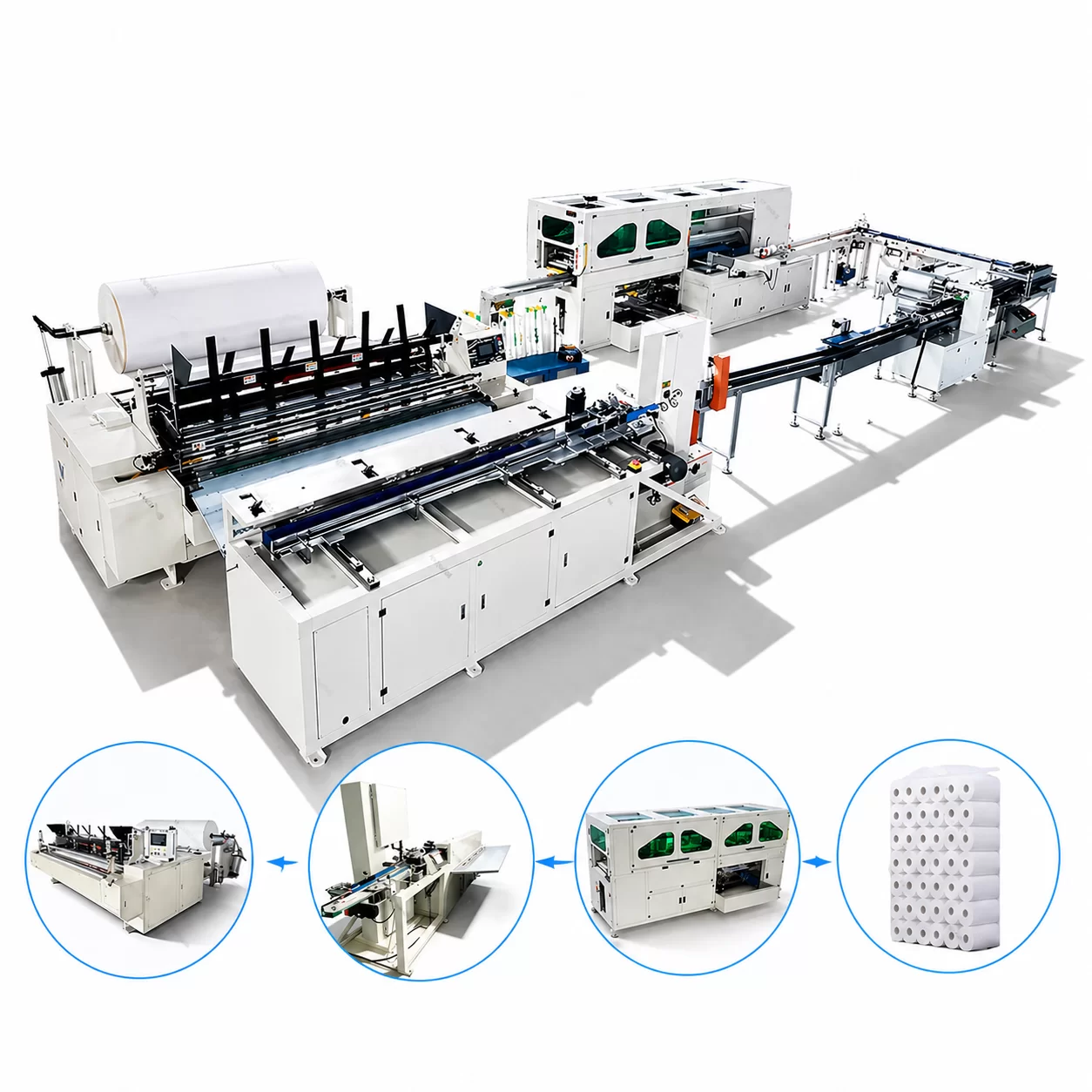
Practical output, operator quantity, installed power and workshop space depend on the final equipment combination, finished-product dimensions, packing format and operating conditions. Confirm these values in the final technical proposal.