
Product Definition and Equipment Matching
This section explains how the finished product specifications affect rewinding, folding, cutting, embossing and packaging equipment selection.
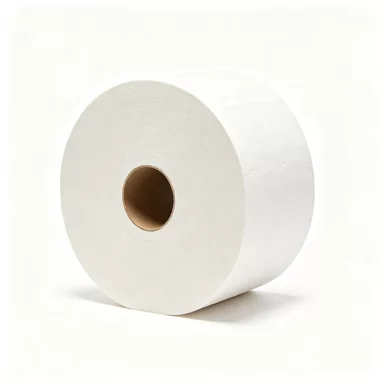
Industrial jumbo tissue rolls are designed for factories, workshops, food-processing areas, public facilities and commercial cleaning applications. The larger roll diameter reduces replacement frequency and makes the product suitable for high-consumption environments.
Finished roll widths commonly range from 200 to 300 mm. Roll diameter can be adjusted between 180 and 300 mm according to the dispenser, sheet count and application. A larger core with a diameter of 60–76 mm supports stable rotation in commercial dispensers and helps maintain roll shape.
The product can be made with one or two plies. Basis weight normally ranges from 20 to 38 gsm per ply, depending on the required strength, absorption and wiping performance. Industrial wiping products may use heavier paper than standard household tissue.
Embossing Configuration
Industrial rolls can be produced without embossing when strength and production efficiency are the main priorities. Edge embossing can be added to hold multiple plies together while keeping most of the sheet surface flat.
Full embossing is also possible when the finished product requires increased bulk or a more recognizable surface pattern. The selection should be based on paper properties, final application and customer sample rather than appearance alone.
Roll Diameter and Core Selection
Roll diameter directly affects sheet count, dispenser compatibility and packaging dimensions. The rewinding machine should provide stable diameter control to maintain consistency between production batches.
Core diameter must match the intended dispenser. Common core sizes include 60 mm, 70 mm and 76 mm, but customized core shafts can be supplied when the product uses a different specification.
The relationship between core diameter, roll diameter and winding tightness should be tested before continuous production. An excessively loose roll may deform during handling, while an excessively tight roll can reduce bulk and affect dispensing.
Cutting and Packaging
Large-diameter tissue logs can be cut using a band saw or another cutting system selected according to the roll diameter and required production capacity. The cutting system should maintain a clean surface and consistent finished width.
Industrial jumbo rolls are commonly wrapped individually to protect the paper from dust and moisture. Multiple rolls can then be loaded into cartons for storage and transportation. Packaging specifications should include the number of rolls per carton, carton dimensions and protective material requirements.
Recommended Production Equipment
A typical system includes a jumbo tissue roll rewinding machine, embossing unit if required, automatic log discharge section, cutting machine and packaging equipment. The final line configuration should be based on the parent roll width, basis weight, finished roll diameter, core diameter and hourly output.